Switching Food for a German Shepherd Puppy Without Stomach Upset
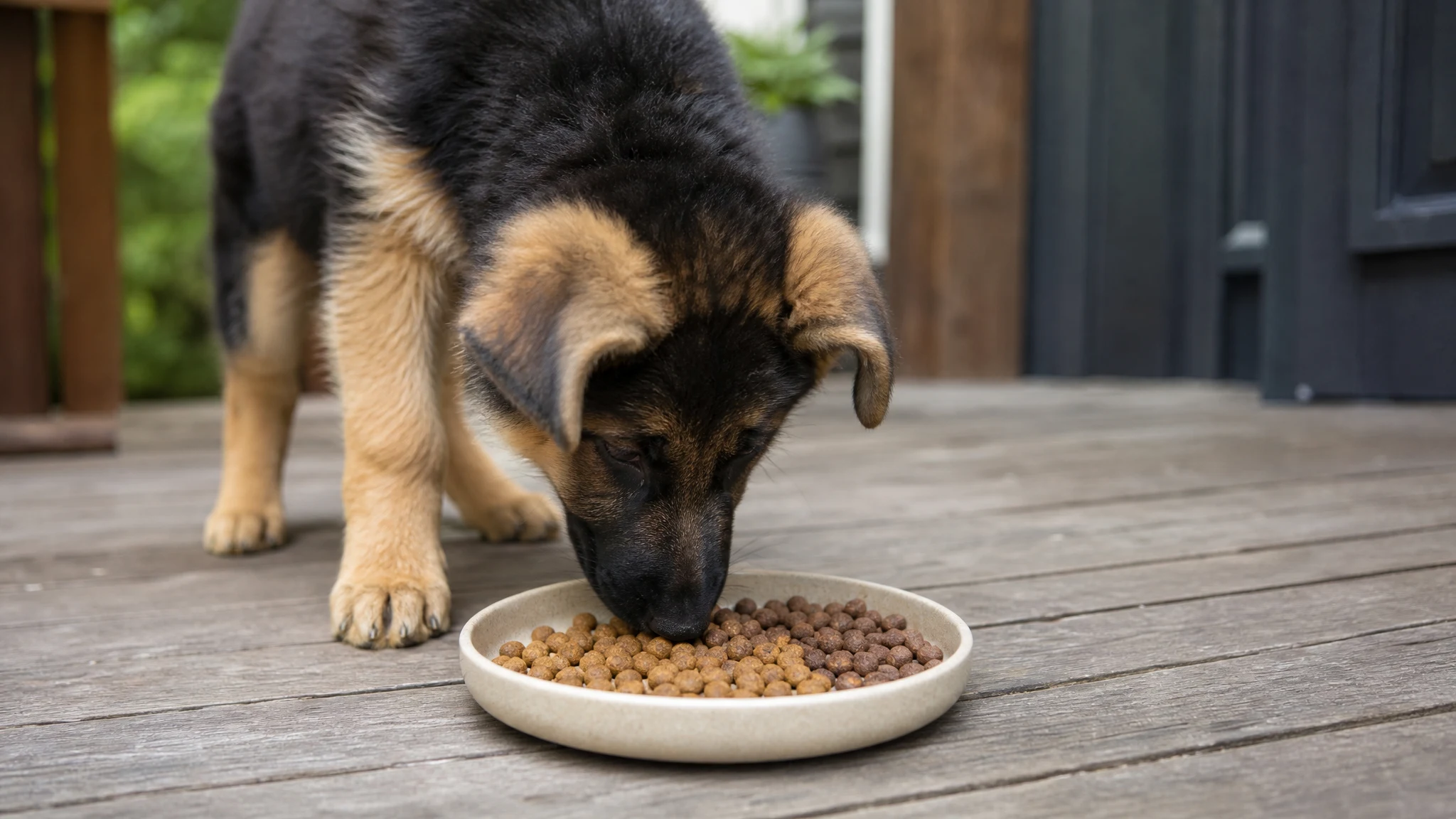
General nutrition information compiled from product labels and published sources, not veterinary advice. Your veterinarian is the right person to choose a diet for your dog, especially one with a health condition.
Changing what your puppy eats sounds simple. You pour a different scoop into the bowl. Yet a sudden swap is one of the most common reasons a young dog ends up with loose stools or a sour stomach.
This guide walks through a gradual switch, step by step. It covers what to gather first, what to watch for, and the mistakes that tend to cause trouble. It applies whether you are moving between puppy formulas or changing brands. It also helps if you are picking the best food for German Shepherd puppy life stages for the first time.
One note on method. We compared label data from brand pages and public sources. We did not run feeding trials or taste tests, and we are not telling you which food to pick. Your veterinarian decides what suits your individual dog.
Why a gradual switch matters for this breed
A dog's gut gets used to a certain recipe. A new one changes the fat level, the protein sources and the fiber, all at once. A sudden change gives the digestive system little time to adjust.
German Shepherds have a few reasons to be more careful than average. Hill's Pet Nutrition notes in its breed page that the breed has a well-documented predisposition to exocrine pancreatic insufficiency (EPI). Its listed signs are weight loss despite a normal appetite, along with abnormal stools. A food change does not cause EPI. But it helps to know that ongoing stool problems in this breed deserve a veterinary look rather than another food swap.
The Merck Veterinary Manual also lists German Shepherd Dogs as an at-risk breed for gastric dilatation and volvulus, often called bloat. It names once-daily feeding, dry kibble only and fast eating as risk factors, and it advises several smaller meals. That affects how you serve food during a transition, which we cover below.
Before you start: decide whether to switch at all
Puppies grow fast, and the food label matters. Two label points are worth checking before any change.
Read the adequacy statement
Since a 2016 AAFCO change, foods that claim growth or all life stages must end the adequacy statement with one of two phrases. One says the food is for growth "including growth of large size dogs (70 lb. or more as an adult)." The other says "except for growth of large size dogs." The Kentucky Administrative Regulations (012 KAR 003:039) mirror this rule. German Shepherd puppies can reach or approach 70 pounds, so the "including" wording is the one to look for.
Whole Dog Journal explains that too much calcium can cause bone and joint abnormalities in large-breed puppies. Hill's says puppy formulas with controlled calcium and phosphorus support skeletal development. The exact calcium limits are best confirmed with the brand or your veterinarian.
Examples of how labels read
These are label details from the brands' own pages, not recommendations.
- Royal Canin's German Shepherd Puppy dry food states it meets AAFCO profiles for growth including growth of large size dogs. It lists 331 kcal ME per cup, as fed, calculated. Its first ingredients are chicken by-product meal, corn, wheat gluten, oat groats and brewers rice.
- Hill's Science Diet Puppy Large Breed Chicken & Brown Rice lists 387 kcal per cup. Its first ingredients are chicken, brown rice, whole grain oats, chicken meal and cracked pearled barley.
- VICTOR Hi-Pro Plus Large Breed Puppy lists a 30 percent minimum protein, 14 percent minimum fat and 365 kcal per cup. Its statement covers all life stages including growth of large size dogs.
Notice that calories per cup differ between these foods. That is why swapping cup for cup is a common mistake, covered in the mistakes section below.
Materials you will need
- The current food, enough to last the whole transition.
- The new food, bought in a small bag if possible, so you are not stuck with a large one if it does not suit your puppy.
- A standard measuring cup or a kitchen scale, so portions stay consistent.
- A clean mixing bowl or a lidded container for blending.
- A notebook or phone note to log meals, stools, energy and appetite.
- The feeding guide from the new food's label or the brand's website.
- Your veterinarian's phone number, in case something looks wrong.
Step-by-step: how to switch
Step 1. Pick a calm week
Avoid starting during travel, boarding, a move, vaccinations or a new house guest. Stress can upset a puppy's stomach on its own. If something goes wrong in a busy week, you will not know whether the food or the stress was the cause.
Step 2. Confirm the puppy is healthy and the stool is steady
Start with a puppy that is eating normally and has regular stools. If the stool is already loose, sort that out with your veterinarian first. Otherwise you cannot judge how the new food is going.
Step 3. Read the new food's own instructions
Some brands give a switching schedule. Hill's, for example, says on its Puppy Large Breed Lamb Meal & Brown Rice product page to switch gradually over 7 days. Treat a schedule like that as a starting point. Check the brand's page for your product, and ask your veterinarian if your puppy has a sensitive stomach.
Step 4. Start with mostly the old food
On the first day or two, serve mostly the old food with a small amount of the new food mixed in. Stir them together so the puppy cannot easily pick out one and leave the other. Keep the total amount at your puppy's normal meal size.
Step 5. Move toward half and half
If stools stay normal and your puppy is eating well, shift to about equal parts old and new for the next couple of days. Keep the daily total the same. You are changing the ratio, not the volume.
Step 6. Move to mostly new food
Next, serve mostly the new food with a small amount of the old. Continue to log stools and appetite. If anything looks off, go back to the previous step and stay there until things settle.
Step 7. Finish on the new food alone
Once your puppy has handled the mostly-new stage without trouble, feed the new food only. Then adjust the portion using the new label's guide, since calories per cup may differ.
Step 8. Keep meals split and slow
Throughout the switch, feed several small meals a day rather than one large one. This follows the Merck Veterinary Manual's advice for at-risk breeds such as German Shepherds. VICTOR's Grain Free Active Dog & Puppy page, for instance, describes four feeding intervals spaced throughout the day. If your puppy gulps food, ask your veterinarian about ways to slow down eating.
Step 9. Watch weight, not just the bowl
OFA's hip dysplasia page says preventing overweight reduces mechanical stress on the hips. It also notes that calorie intake is an environmental factor. Feeding guides are a starting point. Check your puppy's body condition against typical weights by age, such as those in our German Shepherd puppy growth chart by month, and talk with your veterinarian about the right pace of growth.
Using label feeding guides as starting points
Feeding amounts on a label are a guide, not a rule. Royal Canin's German Shepherd Puppy page lists daily amounts by puppy age from 2 to 12 months and by target adult weight of 57, 77 or 97 lb. Hill's says to adjust amounts as needed to maintain optimal weight, and to ask your veterinarian if you are unsure. VICTOR's large breed puppy page gives a chart in cups per day using a standard 8 oz. measuring cup.
When you switch brands, use the new label's chart rather than carrying over the old cup count. Then adjust slowly based on how your puppy looks and feels, and check in with your veterinarian.
Tips for a smoother switch
- Weigh the food if you can. Cup measures vary with kibble shape. A scale keeps portions consistent.
- Keep treats steady. Do not add new chews or table scraps during the transition. Otherwise you cannot tell what caused a change.
- Keep the schedule the same. Feed at about the same times each day.
- Use reward-based training with the new food. A few kibbles from the daily portion can work as training rewards. Use positive reinforcement, in line with the American Veterinary Society of Animal Behavior (AVSAB), and keep the daily total unchanged.
- Store food well. Keep dry food sealed and cool. For fresh or refrigerated products, follow the brand's storage directions. Freshpet, Nom Nom and JustFoodForDogs all ship refrigerated or frozen products with their own handling instructions on their sites.
- Take extra care with fresh foods. Fresh foods usually have different calorie density than kibble. Nom Nom's Pork Potluck page lists 246 kcal per cup (calculated), against 331 kcal for the Royal Canin dry puppy food above. Check each brand's own guide, since some pages direct you to a calculator instead of fixed portions.
Common mistakes to avoid
Switching all at once
This is the classic cause of an upset stomach. Even a better food can cause trouble if it arrives overnight.
Swapping cup for cup
Calories per cup differ between foods, as the examples above show. A cup of one food is not a cup of another. This can lead to a puppy gaining too fast, which is the thing OFA says to avoid for hip stress.
Choosing an adult formula too early
No opened veterinary or breed club source gives a month for moving a German Shepherd to adult food. Hill's food navigation lists adult as 12 months to 7 years, but that is generic and not specific to this breed. Ask your veterinarian when to change.
Treating a grain-free label as a safety feature
The FDA's investigation into diet and canine dilated cardiomyopathy (DCM) has not established a causal link between specific diets and DCM. Its latest public update is dated December 23, 2022, and the agency said it does not plan more public updates until there is meaningful new scientific information. Some products, such as VICTOR's Grain Free Active Dog & Puppy, are grain free and use peas and garbanzo beans. That is a label fact, not a verdict. If you are weighing this, ask your veterinarian.
Changing too many things at once
Do not add supplements, new treats and a new food in the same week. If your puppy has trouble, you will not know why. Ask your veterinarian before adding any supplement.
Assuming a food will fix a health issue
No food prevents, treats or cures hip or elbow dysplasia, allergies, DCM or bloat. Diet is one factor that your veterinarian considers. Prescription diets are something only a veterinarian prescribes.
What results to expect
With a gradual switch, many puppies adjust without obvious trouble. Stools may change a little in color or firmness in the first days, which can be normal while the gut adapts. Appetite and energy often stay steady.
Results vary from puppy to puppy, and no switching plan can promise a perfect outcome. A food that works well for one dog may not suit another. Over the following weeks, you can expect to see a steady, healthy growth pattern if portions are right. Your veterinarian can confirm this at checkups.
When to slow down or call the veterinarian
- Loose stool that lasts more than a day or two: go back one step in the transition and hold there.
- Repeated vomiting, a swollen or hard belly, retching without producing anything, or obvious distress: contact a veterinarian right away. These can be signs of an emergency.
- Weight loss despite a normal appetite, with abnormal stools: this is the pattern Hill's lists for EPI, so ask your veterinarian.
- Itching, ear trouble or skin problems after a new food: mention it to your veterinarian rather than guessing at the cause.
A quick checklist
- Check that the new label says growth "including growth of large size dogs (70 lb. or more as an adult)."
- Choose a calm week and a puppy with steady stools.
- Mix mostly old food with a little new, then shift over the days.
- Keep meals small and spread through the day.
- Switch to the new label's portion guide once the transition is done.
- Track weight and stool, and call your veterinarian about anything that worries you.
Sources
- Hill's Pet Nutrition, German Shepherd breed page
- Orthopedic Foundation for Animals, Hip Dysplasia
- Merck Veterinary Manual, Gastric Dilation and Volvulus in Small Animals
- Whole Dog Journal, nutritional adequacy statements
- Kentucky Administrative Regulations 012 KAR 003:039
- FDA CVM, investigation into diet and canine dilated cardiomyopathy
- Royal Canin, German Shepherd Puppy
- Hill's Science Diet, Puppy Large Breed Lamb Meal & Brown Rice
- VICTOR, Hi-Pro Plus Large Breed Puppy
- VICTOR, Grain Free Active Dog & Puppy
- Nom Nom, Pork Potluck