German Shepherd Puppy Growth Chart: Weight by Month and What Food Has to Do With It
General nutrition information compiled from product labels and published sources, not veterinary advice. Your veterinarian is the right person to choose a diet for your dog, especially one with a health condition.
Most owners looking for a German Shepherd puppy growth chart want one thing: a number to hold their puppy up against. This guide gives you what the published sources say, tells you plainly where they stop, and shows you a better check than the scale alone.
The short version: food matters a great deal during growth, but not because more food makes a better dog. For a large breed, how steadily the puppy grows matters as much as how big it ends up.
In this guide
- What a growth chart can and cannot tell you
- German Shepherd puppy weight by month: what is published
- Body condition score: the check that beats a number
- Why overfeeding is the bigger risk
- How growth formulas are built
- Reading labels: a comparison of label data
- Feeding routine, tracking and the switch to adult food
- Sources
Key takeaways
- Hill's Pet Nutrition lists the adult German Shepherd at roughly 50 to 90 pounds, with males heavier, and calls the breed large.
- We did not find breed-specific weights for each month from the German Shepherd Dog Club of America or other sources we trust, so this guide does not invent a month-by-month table.
- A hands-on body condition check tells you more than any average weight.
- The Orthopedic Foundation for Animals (OFA) names calorie intake as an environmental factor in hip dysplasia and says keeping a dog from becoming overweight reduces stress on the hips.
- For this breed, look for a growth or all life stages food whose label says it covers growth of large size dogs (70 lb. or more as an adult).
- Your veterinarian decides what is right for your individual puppy, including when to change foods.
What a growth chart can and cannot tell you
A growth chart is an average. It blends many dogs, from small-framed females to big-boned males, and flattens them into one line. Your puppy is one dog, not an average.
The adult range alone shows the problem. Hill's Pet Nutrition gives the German Shepherd an adult weight of 50 to 90 pounds, with males heavier. That is a 40-pound spread. A puppy that looks small next to a litter-mate may simply be headed for the lower end of that range.
That is why a chart works best as a rough guide for the trend, not a pass-fail test. What you want to see is steady gain, a healthy shape, and a puppy who is bright and eating well. A sudden stall, a drop, or a puppy who looks thin while eating normally is a reason to call your veterinarian.
Hill's also notes that exocrine pancreatic insufficiency (EPI) is a well-documented predisposition in the breed. Its listed signs are weight loss with a normal appetite and abnormal stools. That is a veterinary question, not something to fix by changing the food bag.
German Shepherd puppy weight by month: what is published
Here is the honest situation. The German Shepherd Dog Club of America's breed page gives no weight figures, and we did not find a monthly weight table from a breed club or veterinary body. Hill's gives the adult range. Whole Dog Journal gives the large-breed definition. Beyond that, we did not find published, sourced monthly figures for the breed.
Many websites do print a German Shepherd puppy weight chart with a pound figure for each month. Without a named source and method, treat those numbers as rough guesses. We are not going to repeat them as fact.
What can be said, from the sources we do trust, is shown below.
| Stage | What published sources say | What they do not say |
|---|---|---|
| Adult size | Hill's: about 50 to 90 pounds, males heavier; large breed | Where your puppy will land in that range |
| Large-breed growth | Whole Dog Journal: the large-breed cutoff is dogs likely to mature at more than 70 pounds | An age at which German Shepherds reach that weight |
| Early puppyhood (from 2 months) | Royal Canin's German Shepherd puppy feeding guide starts at 2 months | A typical weight at 2 months |
| First year (to 12 months) | Royal Canin's guide runs to 12 months, split by expected adult weight of 57, 77 or 97 lb | A typical weight at 6 or 12 months |
| Up to 15 or 18 months | Royal Canin's German Shepherd formula and Hill's large breed puppy formulas are sold as puppy foods up to roughly this age | The right month to move to adult food for your dog |
The Royal Canin figures are worth a second look. The brand's feeding guide sorts puppies by the adult weight you expect: 57, 77 or 97 pounds. That tells you something useful. Even the food maker does not assume every German Shepherd puppy follows one line.
Build your own chart instead
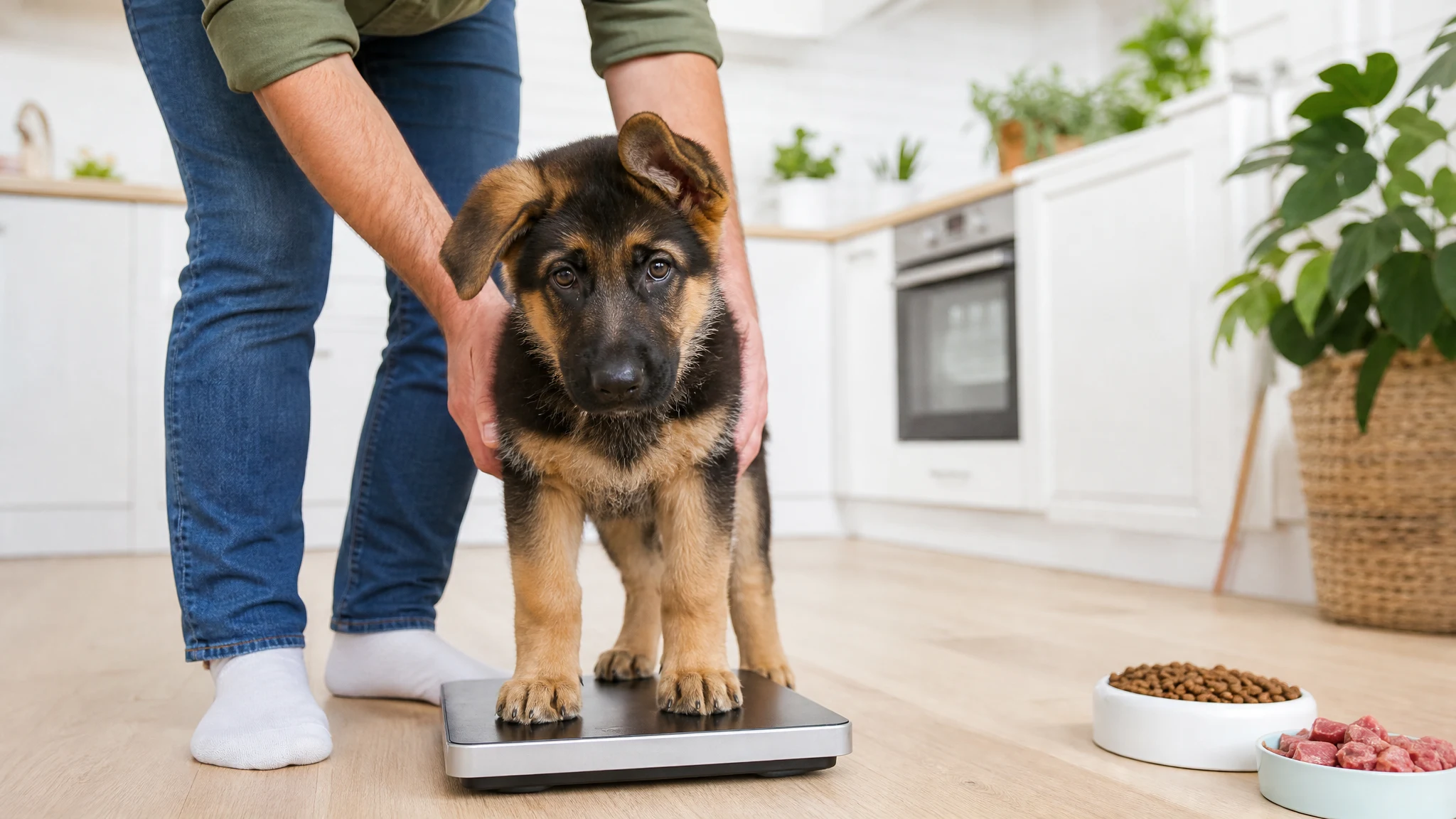
A chart based on your own puppy's records is more useful than an average. Weigh your puppy on the same scale, at the same time of day, every one to two weeks. Many owners weigh themselves holding the puppy, then subtract their own weight.
Write down the date, the weight, and a short note on shape (more on that next). After a few months you will have a line that is specific to your dog. Bring it to puppy visits. Your veterinarian can tell you whether the curve looks right for your dog.
Body condition score: the check that beats a number
A body condition score (BCS) rates how lean or heavy a dog is by looking and feeling, not by weighing. Veterinary teams use a numbered scale, and the exact scale can differ between clinics. Ask yours which one it uses and to show you what the ideal score feels like on your puppy.
You can do a basic version at home in a minute.
- Feel the ribs. Run your flat hand along the side of the chest. You should be able to feel the ribs under a thin layer of padding, without pressing hard. If you have to dig, the puppy is carrying extra weight. If the ribs stand out sharply, the puppy may be too lean.
- Look from above. Stand over your puppy. There should be a visible waist behind the ribs. A straight-sided or bulging outline suggests extra weight.
- Look from the side. The belly should tuck up toward the back legs, not hang level with the chest or sag.
Keep in mind that a growing puppy goes through awkward phases. Long legs, a narrow body and big paws can make a healthy puppy look lanky. Fur on this breed can hide shape, so rely on your hands, not just your eyes.
This check is more useful than a chart for one reason: it catches the problem we care about most, which is a puppy growing heavier than its frame can comfortably carry.
Why overfeeding is the bigger risk
People worry about underfeeding a big, active puppy. For this breed, the more common concern in the sources is the opposite.
Weight and the hips
Hill's describes the German Shepherd as prone to developmental joint disorders. The OFA's hip dysplasia page says calorie intake is an environmental factor, and that preventing overweight reduces mechanical stress on the hips. Genetics matter too, and food cannot change them. But extra weight is one part of the picture that an owner can influence.
No food prevents or treats hip or elbow dysplasia. What the sources support is narrower: keep the puppy lean and growing at a steady pace, and ask your veterinarian to monitor it. If you want to learn about joint screening, the OFA page linked in the sources is the place to start.
Calcium and fast growth
Whole Dog Journal says too much calcium can cause bone and joint abnormalities in large-breed puppies. Hill's says puppy formulas with controlled calcium and phosphorus support skeletal development. Together, these point to a practical rule: do not add calcium or other supplements to a complete puppy food on your own. A complete food is already built to a target, and extras can push past it.
The "just a little more" problem
Overfeeding is rarely one big mistake. It is a heaping scoop, training treats that were never counted, a chew here and a handful of kibble there. Treats and extras still add calories. If your puppy gains too fast, trim the meals slightly and ask your veterinarian before making a big change.
Bloat and meal timing
The Merck Veterinary Manual lists German Shepherd Dogs as an at-risk breed for gastric dilatation and volvulus (GDV, often called bloat). Its listed risk factors include feeding once a day, eating only dry kibble, and eating fast. The advice is several small meals. For a growing puppy, that usually means splitting the daily amount into more than one meal. Ask your veterinarian about the schedule and about what to do if you see signs of bloat, because it is an emergency.
How growth formulas are built
A puppy needs more of some nutrients per day than an adult, in a form that supports bone, muscle and organ development. But a large-breed puppy also needs growth that is not too fast. Formulas for large dogs are built around both ideas.
The AAFCO adequacy statement
Every complete dog food label carries a statement from the Association of American Feed Control Officials (AAFCO) system saying what life stage it is complete for. Since a 2016 change, a food claiming growth or all life stages must end that statement with one of two phrases:
- "including growth of large size dogs (70 lb. or more as an adult)": the food meets the large-size growth nutrient levels.
- "except for growth of large size dogs (70 lb. or more as an adult)": it does not.
This rule is set out in state regulations that mirror AAFCO, such as Kentucky's 012 KAR 003:039. Whole Dog Journal recommends the "including" wording for large-breed puppies. Since German Shepherd puppies can reach or approach 70 pounds, that is the wording to look for. The sources we used do not give a verified calcium cap, so we will say only that large-size growth foods have a lower calcium ceiling than general growth foods.
Two ways a food can qualify
Some labels say the recipe was formulated to meet AAFCO nutrient levels. Others say animal feeding tests using AAFCO procedures substantiated the food. Both are valid routes. Neither tells you how a food will suit your individual puppy.
Calories matter as much as nutrients
Two foods can both be complete for large-breed growth and still differ a lot in calories per cup. A cup of one food is not a cup of another. This is why switching brands and keeping the same scoop can change your puppy's intake by a noticeable amount.
Reading labels: a comparison of label data
We compared label data from brand product pages. We did not run feeding trials or taste tests, and we did not feed any of these foods to dogs. The table shows only what the brands publish. Where a brand's page did not list a figure, we say so, and you should check with the brand.
| Food | Large-size growth wording | Calories per cup (brand figure) | First ingredient |
|---|---|---|---|
| Royal Canin German Shepherd Puppy (dry) | Growth including large size dogs (70 lb. or more as an adult) | 331 kcal ME, calculated | Chicken by-product meal |
| Hill's Science Diet Puppy Large Breed Chicken & Brown Rice | Feeding-test statement for growing puppies; large breed puppy, adult weight over 55 lb | 387 kcal | Chicken |
| Hill's Science Diet Puppy Large Breed Lamb Meal & Brown Rice | Feeding-test statement for growing puppies; large breed puppy, adult weight over 55 lb | 378 kcal | Lamb meal |
| VICTOR Hi-Pro Plus Large Breed Puppy | All life stages including growth of large size dogs (70 lb. or more as an adult) | 365 kcal | Chicken |
A few things stand out. Royal Canin's figure is the lowest per cup here, which means a cup supplies less energy than a cup of the Hill's or VICTOR foods listed. The Hill's pages list protein, fat and fiber on a dry-matter basis only, so their numbers cannot be compared straight across to brands that list minimums as fed. And for the Hill's large-breed pages, the product pages we read did not show the exact "including growth of large size dogs" wording, so check the bag.
Kibble size was not published with dimensions for any of these, so we cannot compare it. If your puppy gulps food, ask your veterinarian about slowing down meals.
Grain-free and the heart question
Grain-free is not a growth requirement. The FDA's most recent public update on its investigation into diets and canine dilated cardiomyopathy (DCM) is dated December 23, 2022. The agency says it has not established a causal link between specific diets and DCM. If you are weighing a grain-free recipe for a breed that is also listed with DCM concerns, talk with your veterinarian first.
Fresh and all life stages foods
Some fresh-food brands, including Nom Nom, Freshpet and JustFoodForDogs, state that certain recipes are formulated for all life stages including growth of large size dogs. They publish calories in different units than kibble makers, so comparing a cup to a cup is not reliable. If you consider a fresh food, check the brand's own feeding guidance and ask your veterinarian how to portion it.
For a fuller side-by-side of label details, see our label-by-label comparison of puppy foods for German Shepherds.
Feeding routine, tracking and the switch to adult food
Treat the label as a starting point
Feeding guides on bags and brand pages are starting points. Hill's says to adjust amounts as necessary to maintain optimal weight and to ask your veterinarian if you are unsure. The Hill's lamb recipe page also advises switching foods gradually over 7 days. Use the guide for your puppy's age and expected adult weight, then adjust using the body condition check and your weight log.
A simple routine
- Measure each meal with a proper measuring cup or kitchen scale, not a scoop that changes size.
- Split the day's food into more than one meal, in line with the Merck advice on small meals for at-risk breeds.
- Count treats as part of the day's food.
- Weigh and score your puppy every one to two weeks.
- Write down changes in appetite, stools and energy, and bring the notes to your veterinarian.
When to move to adult food
We did not find any breed club or veterinary source that gives a German Shepherd-specific age for leaving puppy food. Hill's generic life-stage menu lists adult as starting at 12 months, but that is not specific to this breed. Royal Canin sells its German Shepherd puppy formula for a longer window, and Hill's large-breed puppy formulas run up to 18 months. Large breeds are often switched later than small ones, but the right month for your dog is a question for your veterinarian, who can look at the actual dog.
When to call the vet
- Weight is dropping or flat while appetite is normal.
- Stools are abnormal for more than a day or two.
- The puppy is gaining faster than you expected or looks heavy by the rib check.
- You see limping, bunny-hopping or reluctance to rise, which the OFA and other sources connect with joint problems.
- The belly looks swollen, or the puppy is retching without producing anything. Treat that as an emergency.
A growth chart can start the conversation, but your puppy's own records, a hands-on body check and your veterinarian's advice are what really guide feeding.
Sources
- German Shepherd Dog Club of America, About the breed
- Hill's Pet Nutrition, German Shepherd breed page
- Orthopedic Foundation for Animals, Hip Dysplasia
- Merck Veterinary Manual, Gastric Dilation and Volvulus in Small Animals
- Whole Dog Journal, In the Fine Print: Nutritional Adequacy Statements
- Kentucky Administrative Regulations 012 KAR 003:039
- FDA Center for Veterinary Medicine, investigation into diets and canine dilated cardiomyopathy
- Royal Canin, German Shepherd Puppy product page
- Hill's Pet Nutrition, Science Diet Puppy Large Breed product page
- VICTOR, Hi-Pro Plus Large Breed Puppy product page