Signs Your German Shepherd Puppy's Food Isn't a Good Fit
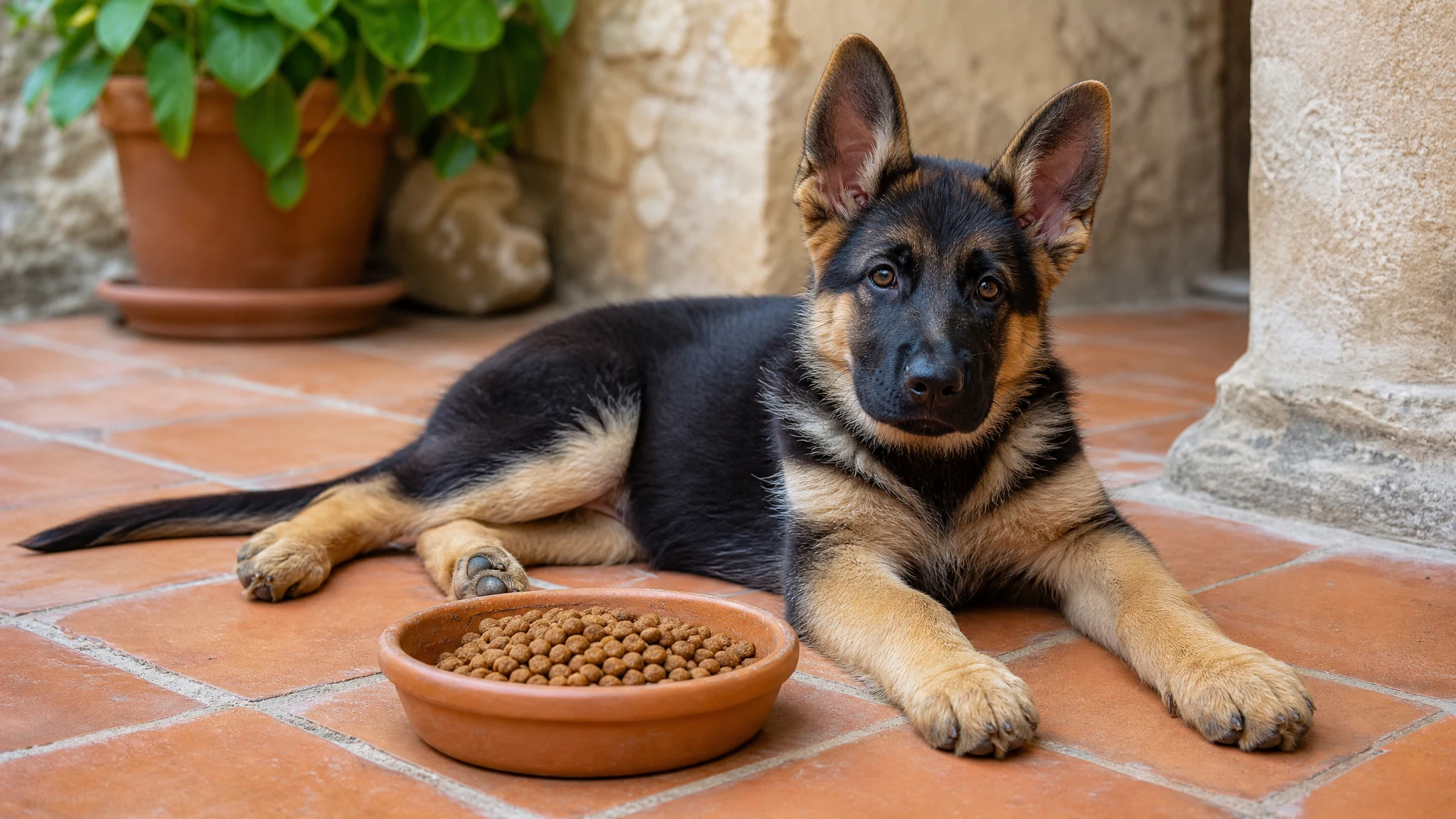
General nutrition information compiled from product labels and published sources, not veterinary advice. Your veterinarian is the right person to choose a diet for your dog, especially one with a health condition.
Every puppy owner wants to find a good food for German Shepherd puppy growth, and most of us pick a bag based on a label and a hope. The real test comes after the bag is open. Your puppy's stool, energy, body shape and appetite tell you whether the formula is working.
This guide walks you through a simple, repeatable check. It will help you spot signs that a food may not suit your puppy, and decide when the question belongs with your veterinarian.
One honest note on method: when this page compares foods, it compares label data published by the brands. We have not run feeding trials or taste tests. A label can tell you what a food is built to do. Only your own puppy can show you how the food is working for them.
Why this breed needs a closer look
German Shepherds are a large breed. Hill's Pet Nutrition lists adult weight at roughly 50 to 90 pounds, with males heavier. Whole Dog Journal defines a large-breed puppy as one likely to mature at more than 70 pounds, so many German Shepherd puppies fall in or near that group.
That matters for food. Hill's says puppy formulas with controlled calcium and phosphorus support skeletal development. Whole Dog Journal adds that too much calcium can cause bone and joint abnormalities in large-breed puppies. A food that suits a small-breed puppy may not suit yours.
The breed also has some known health patterns. Hill's notes a well-documented predisposition to exocrine pancreatic insufficiency (EPI) and to developmental joint disorders. The Merck Veterinary Manual lists German Shepherd Dogs as an at-risk breed for bloat, also called gastric dilatation-volvulus (GDV). None of these is caused or fixed by one bag of food. They are reasons to watch closely and to involve your vet early.
What you need
- The food bag or can, with the full label (not just the front)
- A kitchen scale or the measuring cup you actually use
- A notebook or phone notes app for a daily log
- Your puppy's current weight and past weights
- A growth reference, such as our German Shepherd puppy growth chart by month
- Your veterinarian's phone number, for questions that come up along the way
Step-by-step: how to check whether the food fits
Step 1: Read the adequacy statement first
Find the small print that begins with something like "formulated to meet the nutritional levels established by the AAFCO Dog Food Nutrient Profiles." This statement is the first filter, and it is easy to skip.
Since the 2016 AAFCO change, a food claiming growth or all life stages must end that statement one of two ways. It says either "including growth of large size dogs (70 lb. or more as an adult)" or "except for growth of large size dogs (70 lb. or more as an adult)." Kentucky's state regulation (012 KAR 003:039) mirrors this rule.
For a German Shepherd puppy, the "including" wording is the one to look for. If your bag says "except," or says nothing about large-size growth, that is a mismatch before your puppy has eaten a bite.
For example, Royal Canin's German Shepherd Puppy dry food states it meets AAFCO profiles for growth including growth of large size dogs. You can read the full label on the Royal Canin product page. Hill's Science Diet Puppy Large Breed recipes are also sold as large-breed puppy foods, and their details are on the Hill's product page. Naming these is not a recommendation. They show what the wording looks like.
Step 2: Check that the food is meant for growth at all
Some "adult" or "maintenance" foods are fine for grown dogs and wrong for a puppy. The statement should say growth or all life stages. A general puppy food that is not large-breed specific, such as Hill's Science Diet Puppy Chicken & Brown Rice, may be complete for growth but does not carry the large-size growth label. Ask your vet whether that gap matters for your puppy.
Step 3: Start a two-week log
Write down these items every day:
- Amount fed and how many meals
- How fast your puppy eats, and whether they finish
- Stool: firm, soft, loose, or any mucus or blood
- Gas, vomiting or belly noises
- Itching, ear scratching or paw licking
- Energy and mood
One bad day means little. A pattern across days is what you are looking for.
Step 4: Watch the stool and digestion
Stool is the most useful daily signal. A puppy who is adjusting to a new food may have softer stools for a few days. Hill's advises switching foods gradually over about 7 days in its feeding notes for its large-breed lamb recipe, and that is a sensible rule for any change.
Signs the food may not be a fit include:
- Loose stool that lasts well beyond the transition week
- Frequent gas or a bloated-looking belly after meals
- Repeated vomiting
- Large, pale or greasy-looking stools
Persistent digestive trouble can have many causes, including parasites and infections, not just the food. Hill's lists weight loss with a normal appetite plus abnormal stools as signs linked to EPI in German Shepherds. If you see that combination, call your vet instead of changing foods again on your own.
Step 5: Check body condition and growth pace
Look at your puppy from above and from the side. You should be able to feel the ribs under a light covering, and see a waist behind the ribs. A puppy who looks round, or who is gaining faster than the growth chart range, may be getting more calories than they need.
This is not cosmetic. The Orthopedic Foundation for Animals (OFA) says calorie intake is an environmental factor in hip dysplasia, and that keeping a dog from becoming overweight reduces mechanical stress on the hips. That does not mean any food prevents or treats hip or elbow problems. It means that keeping your puppy lean is one thing you can control.
Compare your puppy's weight with the month-by-month growth chart. Treat it as a rough guide, since healthy puppies vary. If your puppy is well above or below the range, bring the numbers to your vet.
Step 6: Compare the feeding guide with what you actually feed
Many owners overfeed without noticing. Brand feeding charts are starting points, not rules. Royal Canin's German Shepherd Puppy page, for example, lists daily amounts by age and expected adult weight. VICTOR's large-breed puppy page gives cups per day by age and weight using a standard 8 oz. measuring cup. Hill's says to adjust amounts as needed to maintain optimal weight and to ask your vet if unsure.
Measure for a few days. If you are scooping by eye, you may be well over the chart. Treats count too, so include them in your log.
Calories vary between foods, which is why you cannot swap by volume. Label data shows 331 kcal per cup for Royal Canin German Shepherd Puppy, 387 for Hill's Puppy Large Breed Chicken & Brown Rice, and 365 for VICTOR Hi-Pro Plus Large Breed Puppy. A cup of one is not a cup of another, so always recalculate when you switch.
Step 7: Look at coat, skin and ears
Chewy's breed guide lists seasonal and food allergies among conditions seen in German Shepherds. Constant itching, recurring ear trouble, paw chewing or patchy skin can have many causes, including fleas, environment and food. You cannot sort these out by guessing at ingredients.
If you suspect a food reaction, ask your vet about a structured elimination trial. Any therapeutic or prescription diet is something only a veterinarian prescribes.
Step 8: Review how and when you feed
Sometimes the food is fine and the feeding routine is the problem. The Merck Veterinary Manual lists once-daily feeding, dry kibble only and fast eating among risk factors for GDV, and advises multiple small meals. If your puppy gulps food, gets one large meal a day or is very active right after eating, talk to your vet about changing the routine.
Bloat is an emergency. A swollen, tight belly, unproductive retching and restlessness need immediate veterinary care.
Step 9: Read the ingredient list with a skeptical eye
Ingredient lists are not a quality score. Marketing language such as "premium" or "natural" has no bearing on how a puppy does on a food. Look at the first five ingredients and the guaranteed analysis, then ask what is missing.
For instance, the Royal Canin German Shepherd Puppy label lists chicken by-product meal, corn, wheat gluten, oat groats and brewers rice first. The VICTOR Hi-Pro Plus Large Breed Puppy label starts with chicken, chicken meal and brown rice. Both are labeled for large-size growth. The lists look different, and neither tells you how your puppy will do.
On grain-free foods, be careful. The FDA's investigation into a possible link between certain diets and canine dilated cardiomyopathy (DCM) has not established a causal link between specific diets and DCM. Its last public update was December 23, 2022, and the agency said it did not plan further updates without meaningful new science. Do not pick or avoid a food based on a slogan about grains. Ask your vet.
Step 10: Decide, then make one change at a time
After two weeks of notes, you will usually land in one of three places:
- Everything looks steady. Keep going and recheck monthly.
- Mild issues, such as soft stool or slightly fast weight gain. Adjust the portion or meal schedule first, and call your vet if it persists.
- Clear or worrying signs, such as vomiting, weight loss or blood in stool. Call your vet before changing anything.
If you do switch foods, change only the food. Transition over about a week, and keep the log going.
Quick reference: signs and what they might mean
| What you see | Possible food-related cause | Next step |
|---|---|---|
| Loose stool past one week on a new food | Too-fast switch, overfeeding, or poor tolerance | Review portion and transition, then call your vet |
| Weight gain above the usual range | Calories too high, treats not counted | Measure portions, compare with growth chart, ask your vet |
| Weight loss with a good appetite | Not a food-fit issue alone; EPI is one possibility in this breed | Call your vet promptly |
| Itching, ear or paw problems | Possible food reaction, or non-food causes | Ask your vet about next steps |
| Bag says "except for growth of large size dogs" | Label mismatch for this breed | Ask your vet about a large-size growth formula |
| Gulping, one big meal a day | Feeding routine, not the recipe | Split into smaller meals and slow eating |
Tips
- Take a photo of your puppy from above and from the side every two weeks. Changes in shape are easy to miss day to day.
- Keep the bag or a photo of the label and lot number in case you need to share it with your vet.
- Weigh your puppy on the same scale at the same time of day.
- Use part of the daily kibble for training so treats do not add extra calories.
- Fresh and refrigerated foods list "all life stages including growth of large size dogs" on some labels, such as Freshpet and Nom Nom recipes. Check each specific recipe's statement on the brand's own page, and note that they do not publish a kibble size because they are not kibble.
Common mistakes to avoid
- Switching foods too often. Each change resets your observations and can upset digestion.
- Blaming the food for everything. Parasites, stress, new treats and table scraps can all cause the same signs.
- Adding supplements, especially calcium. Whole Dog Journal warns that too much calcium can harm large-breed puppy bone development. Ask your vet before adding anything.
- Feeding to the bag's top number. Charts are starting points. Adjust to your puppy's body condition.
- Chasing "grain free" or "high protein" as quality signals. Neither is proof of a good fit for your puppy.
- Ignoring the growth pace. Being too heavy early can matter just as much as being thin.
- Self-diagnosing. Persistent symptoms deserve an exam.
What results to expect
If a food suits your puppy, you may see firm, regular stools, steady energy, a visible waist and weight that tracks along a reasonable growth curve. Many owners notice these within a few weeks, though puppies differ and no food guarantees any outcome.
If your notes show a clear pattern of trouble, you will at least walk into the vet's office with useful details. Vets can decide whether a different formula, a different feeding routine or a diagnostic test makes sense for your individual puppy.
Be cautious about how long a puppy stays on puppy food. No source we relied on gives a German Shepherd specific age for moving to adult food. Hill's generic life-stage navigation lists adult as starting at 12 months, but that is not breed specific. Ask your vet when to switch, based on your puppy's growth and condition.
The bottom line
A good food for German Shepherd puppy growth is one with a large-size growth statement on the label, fed in measured amounts, and well tolerated day to day. Read the label, keep a log, watch body condition and bring patterns to your vet. That routine will tell you more than any ranking list.
Sources
- Hill's Pet Nutrition, German Shepherd breed page
- Orthopedic Foundation for Animals, Hip Dysplasia
- Merck Veterinary Manual, Gastric Dilation and Volvulus in Small Animals
- FDA CVM, Investigation into Potential Link between Certain Diets and Canine Dilated Cardiomyopathy
- Whole Dog Journal, In the Fine Print: Nutritional Adequacy Statements
- Kentucky Administrative Regulations, 012 KAR 003:039
- Chewy, German Shepherd breed guide
- Royal Canin, German Shepherd Puppy product page
- VICTOR, Hi-Pro Plus Large Breed Puppy product page