Homemade Food for a German Shepherd Puppy: What Vets Say About the Risks
General nutrition information compiled from product labels and published sources, not veterinary advice. Your veterinarian is the right person to choose a diet for your dog, especially one with a health condition.
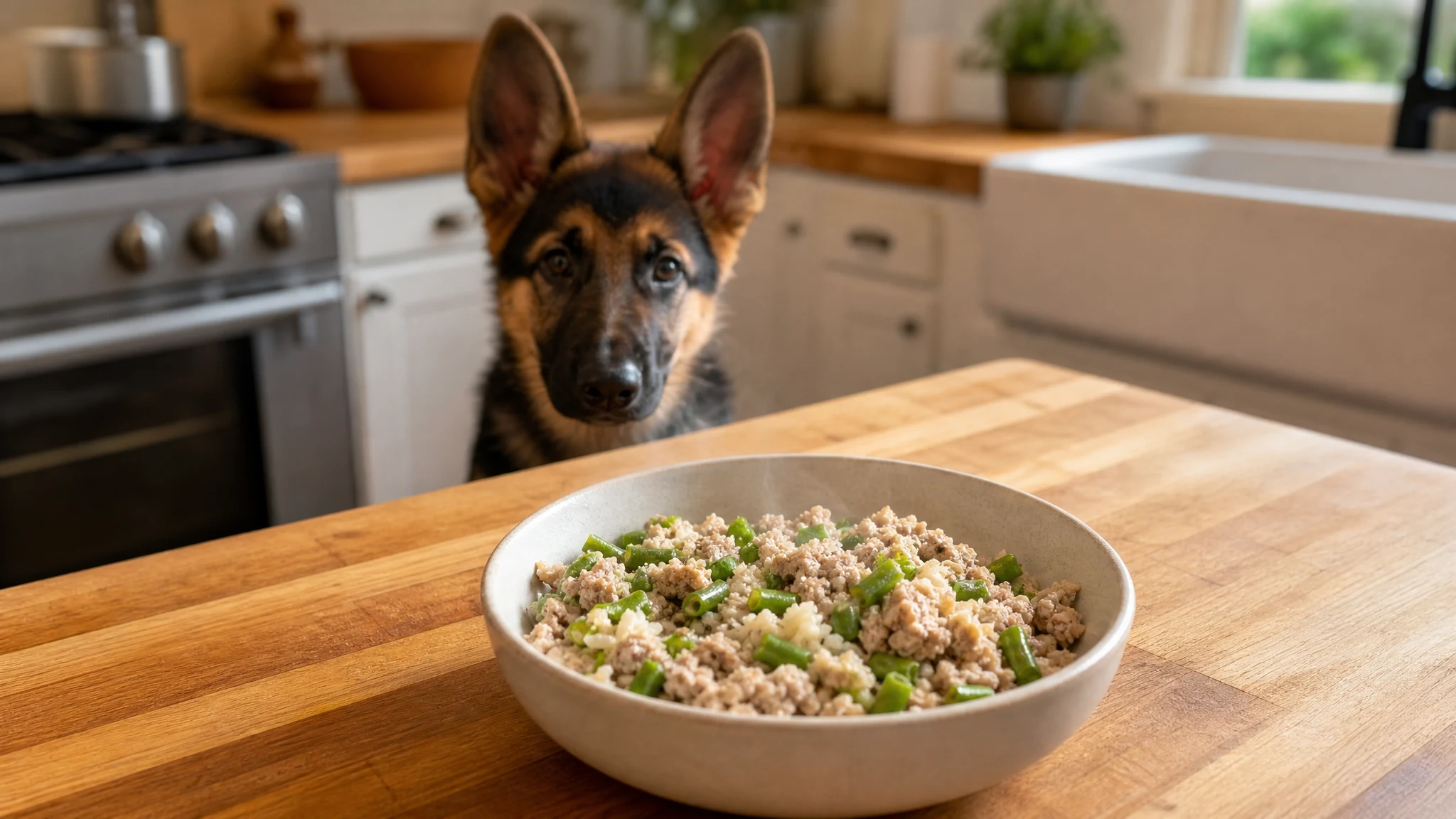
Many owners want to cook for their puppy. The urge makes sense. You can see every ingredient, and it feels caring. But homemade food for a German Shepherd puppy is a harder job than cooking for an adult dog, because this breed is large and grows fast.
This guide is not a recipe. It walks through how to decide whether homemade feeding is worth it, what the risks are, and how to plan it safely with your own veterinarian. We compared label data and published sources. We did not run feeding trials or taste tests, and we did not cook or feed anything ourselves.
Why Growth Makes This Different
The Hill's Pet Nutrition German Shepherd breed page lists the breed as large, with adults commonly 50 to 90 pounds. Males run heavier. A puppy has to build that frame in a little over a year.
Hill's says puppy formulas with controlled calcium and phosphorus support skeletal development. Whole Dog Journal goes further. It says too much calcium can cause bone and joint abnormalities in large-breed puppies. It defines the large-breed cutoff as dogs likely to mature at more than 70 pounds.
That is the core risk of home cooking. A mix of chicken, rice and vegetables can look healthy and still be off in minerals. You cannot see calcium on a plate. Adding a calcium source by guesswork is exactly where trouble can start.
What the Label Rules Tell You
Commercial dog foods follow a label rule you can use as a yardstick. Kentucky Administrative Regulations (012 KAR 003:039), which mirror the AAFCO rule, say a food claiming growth or all life stages must end its adequacy statement one of two ways. It says either "including growth of large size dogs (70 lb. or more as an adult)" or "except for growth of large size dogs (70 lb. or more as an adult)."
German Shepherd puppies can reach or approach 70 pounds. Whole Dog Journal recommends the "including" wording for them. A homemade recipe has no such statement. So the question for any recipe is simple: who checked it against large-size growth needs?
Health Context That Affects Feeding
The Hill's breed page says German Shepherds are prone to developmental joint disorders. The Orthopedic Foundation for Animals (OFA) says calorie intake is an environmental factor in hip dysplasia. It also says keeping a dog from becoming overweight reduces mechanical stress on the hips.
This does not mean any food prevents or treats hip or elbow problems. It means portions matter, and a homemade diet without careful calorie counts can drift toward too much or too little. Your veterinarian decides what is right for your individual puppy.
Two other points from the sources:
- The Merck Veterinary Manual lists German Shepherd Dogs as an at-risk breed for gastric dilatation-volvulus (bloat). Its risk factors include once-daily feeding, dry kibble only, and fast eating. The advice is multiple small meals.
- Hill's notes a well-documented breed predisposition to exocrine pancreatic insufficiency (EPI). Signs include weight loss with a normal appetite and abnormal stools. If you see that, call your veterinarian rather than adjusting the menu yourself.
How to Plan Homemade Feeding Safely
Here is a step-by-step process. It aims to lower the risks, not remove them. Results vary by puppy.
Materials You Will Need
- A complete written recipe made for large-breed puppy growth, from a source your veterinarian accepts
- A digital kitchen scale, since cups are not accurate for home recipes
- Measuring tools and storage containers
- A notebook or app to log meals, weight and stool quality
- Any supplement or mineral mix your recipe specifies, named by brand and product, chosen with your veterinarian
- A scheduled visit for regular weigh-ins
We are not listing ingredient amounts or supplement doses here. Those belong in a recipe built for your puppy. Do not take them from a general article.
Step 1: Talk to your veterinarian first
Say plainly that you want to cook for your German Shepherd puppy. Ask whether your puppy's growth, weight and health history make that reasonable. Ask who they trust to write or review a recipe, such as a veterinary nutrition service.
Bring your puppy's current weight. If you want a reference for typical size by age, see our German Shepherd puppy growth chart by month. Treat it as a guide to talk through, not a target to hit.
Step 2: Get a recipe built for large-size growth
A recipe pulled from a blog or social post is a weak starting point. Look for one that states it was balanced for growing, large-breed puppies and that lists every ingredient and supplement by weight. If it does not mention calcium and phosphorus control for large puppies, ask why not.
Also be wary of recipes written for "all dogs." Adult dogs and large-breed puppies have different mineral needs, according to the sources above.
Step 3: Follow the recipe exactly
Weigh everything. Do not swap proteins, skip the supplement, or add extras like bones, dairy or a calcium powder because it seems harmless. Each change can shift the mineral balance.
If your puppy refuses an ingredient, go back to your veterinarian or the recipe's author for a replacement. Do not improvise.
Step 4: Split the day into several meals
Because of the bloat risk noted by the Merck Veterinary Manual, plan multiple small meals instead of one large one. Slow the pace if your puppy gulps. Your veterinarian can advise on meal count and timing for your puppy's age.
Step 5: Track weight, body shape and stools
Weigh your puppy on a schedule your veterinarian suggests. Write down the number and how the puppy looks and feels. Ask your veterinarian to show you how to judge body condition by touch.
A lean, steady growth pattern is what you want to discuss, in line with the OFA point about avoiding excess weight. Note any change in appetite, energy or stool, and report it.
Step 6: Recheck the plan as your puppy grows
Needs shift over months. No source we found gives a breed-specific age for moving from puppy food to adult food. Hill's food navigation lists Adult as 12 months to 7 years, but that is generic and not specific to German Shepherds. Large breeds are often switched later, so ask your veterinarian when and how to change the plan.
Common Mistakes to Avoid
- Adding calcium on your own. Extra calcium is not a safe "bonus" for a large-breed puppy, per Whole Dog Journal.
- Using an adult dog recipe. It may not be built for growth at all.
- Eyeballing portions. Without a scale, calories and minerals drift.
- Feeding once a day. The Merck Veterinary Manual lists once-daily feeding as a bloat risk factor.
- Treating food as medicine. No food is shown here to prevent or cure hip dysplasia, allergies or heart disease. Only a veterinarian can prescribe a therapeutic diet.
- Skipping checkups. A puppy can look fine while a mineral problem builds slowly.
- Copying a recipe that worked for another dog. Your puppy's size, age and health are different.
What to Expect
If a recipe is complete, measured carefully and reviewed by your veterinarian, many owners find their puppy eats well and holds a steady growth pattern. That is a hopeful outcome, not a promise. Home cooking takes weekly time for shopping, weighing, cooking and storing. It can also cost more than a commercial food, so check your own grocery costs.
If the recipe is incomplete, problems may show up slowly. Watch for poor stools, weight changes or limping, and call your veterinarian early. Do not wait.
A Middle Path: Commercial Foods With Large-Size Growth Statements
If the work or risk feels like too much, consider a commercial food whose label says it meets AAFCO levels for growth including large size dogs. Based on label data on the brand pages, these examples carry that wording:
- Royal Canin German Shepherd Puppy, a dry food. The label says it is formulated for growth including growth of large size dogs (70 lb. or more as an adult).
- VICTOR Hi-Pro Plus Large Breed Puppy, a dry food with an all life stages statement that includes growth of large size dogs.
- Hill's Science Diet Puppy Large Breed Chicken & Brown Rice, a dry food. The label says animal feeding tests using AAFCO procedures substantiate it for growing puppies.
If you like fresh food, some brands also publish all life stages statements that include large-size growth. Examples are Freshpet, Nom Nom and JustFoodForDogs. We compared label wording only. Check each brand for current ingredients and feeding guidance, and ask your veterinarian before switching.
One more note on label reading. VICTOR's Grain Free Active Dog & Puppy lists peas and garbanzo beans among its first ingredients. The FDA's investigation into diets and canine dilated cardiomyopathy (DCM) has not established a causal link between specific diets and DCM. Its latest public update was dated December 23, 2022. Ask your veterinarian about any grain-free choice.
Feeding amounts on any package are starting points. Adjust them with your veterinarian based on your puppy's body condition.
Questions to Bring to Your Veterinarian
- Is homemade feeding reasonable for my puppy's age and health?
- Who can write or check a recipe for large-size growth?
- How often should we weigh and recheck?
- How many meals a day fit my puppy?
- When should we move to an adult plan?
Sources
- Hill's Pet Nutrition, German Shepherd breed page
- Orthopedic Foundation for Animals, Hip Dysplasia
- Merck Veterinary Manual, Gastric Dilation and Volvulus in Small Animals
- Whole Dog Journal, In the Fine Print: Nutritional Adequacy Statements
- Kentucky Administrative Regulations, 012 KAR 003:039
- FDA CVM, Investigation into Potential Link between Certain Diets and Canine Dilated Cardiomyopathy
- German Shepherd Dog Club of America, About the Breed