The Best Food for German Shepherd Puppies, Compared Label by Label
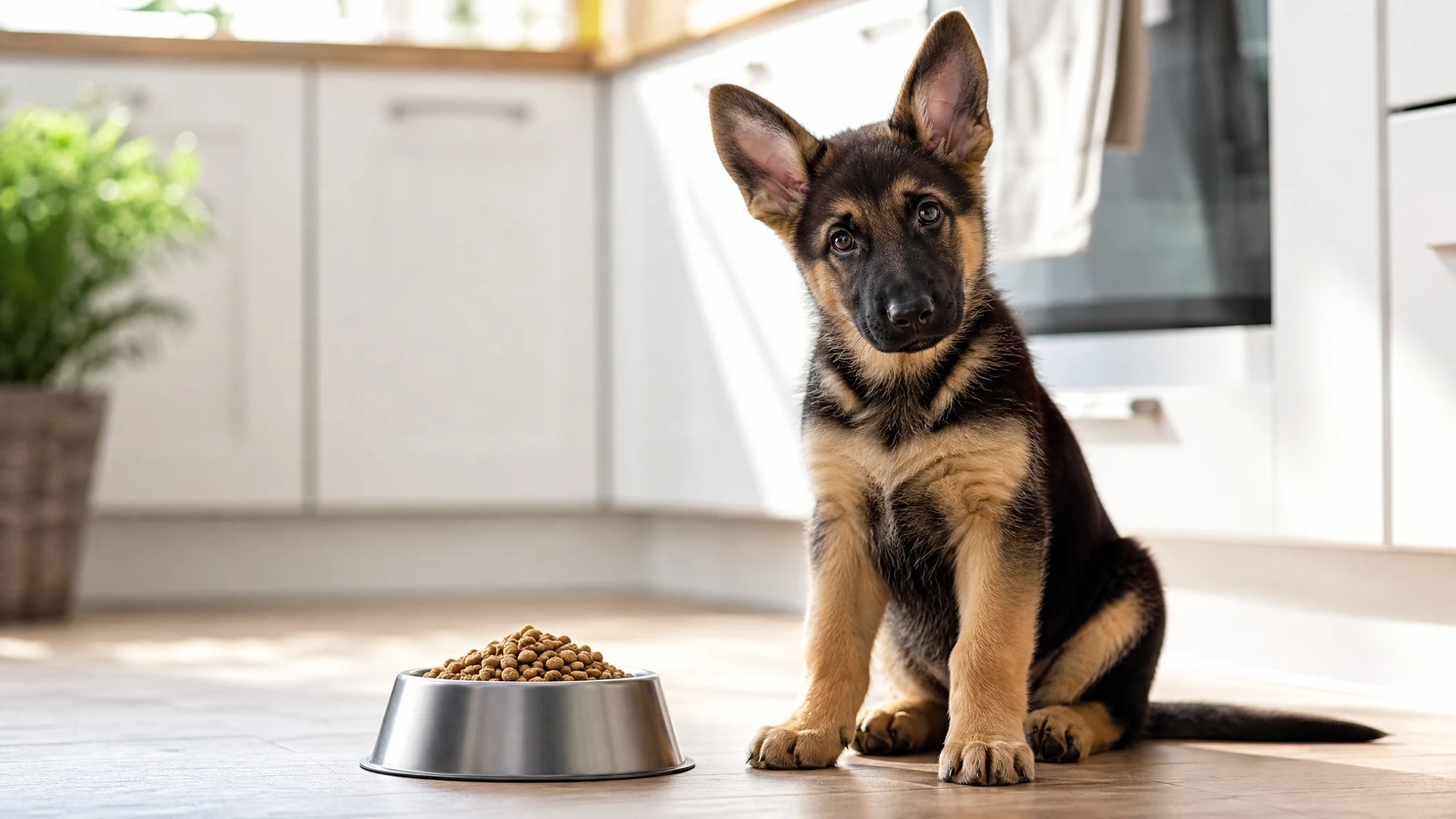
General nutrition information compiled from product labels and published sources, not veterinary advice. Your veterinarian is the right person to choose a diet for your dog, especially one with a health condition.
Choosing german shepherd puppy food is harder than it looks. Every bag says it supports growth. Very few say how, and the useful details sit in small print on the back or on the brand's own product page.
This guide reads that small print. It compares twelve foods from six brands that state they suit a growing puppy. It does not crown a winner, because the best food for German Shepherd puppies depends on the individual dog, and a veterinarian is the right person to decide that.
Key takeaways
- The adequacy statement is the first thing to read. For a German Shepherd puppy, look for wording that says the food covers growth of large size dogs (70 lb. or more as an adult).
- Hill's lists German Shepherds at 50 to 90 pounds as adults, so many puppies will reach or approach that 70 pound line.
- Protein and fat percentages on different pages are not always comparable. Some brands publish as-fed minimums, others publish dry-matter figures.
- Calories per cup vary a lot, from 246 for a fresh food to 390 for a dry one. Feeding charts are starting points, and a lean puppy is the goal.
- Calcium figures and kibble sizes were not published on the pages we read. Ask the brand.
- Nothing here is a claim that a food prevents or treats any disease. Your veterinarian decides what suits your dog.
Table of contents
- How this comparison was done
- What a German Shepherd puppy's growth asks of a food
- How to read a puppy food label
- The foods, compared label by label
- Notes on each brand
- Feeding amounts, meal timing and health questions
- How to choose and switch
How this comparison was done
We compared label data. For each food, we read the brand's own product page and recorded the adequacy statement, the first five ingredients, the published protein, fat and fiber figures, and the calories.
We did not run feeding trials. We did not do taste tests. We did not feed any of these foods to a puppy. Nothing below is a result from a kitchen or a kennel. It is a side-by-side reading of what each company printed.
That has limits. A label cannot tell you how a food digests in your puppy, how it smells, or whether your dog will eat it. It also cannot show how a company sources or tests its ingredients. Treat this as a way to narrow the field, then talk to your veterinarian.
We left out any food whose page did not say it suits a growing puppy. Canned puppy food is not covered, because no suitable label data was available. Where a number was not published, the table says so rather than guessing.
What a German Shepherd puppy's growth asks of a food
A large breed with a wide adult size range
The German Shepherd Dog Club of America is the parent breed club, and it names the breed the German Shepherd Dog. Hill's Pet Nutrition describes the breed as large, with adults commonly 50 to 90 pounds, and males heavier.
That range matters for food. A puppy that will end up near or above 70 pounds sits in the size class that pet food rules treat differently.
Why large-size growth wording matters
Hill's says puppy formulas with controlled calcium and phosphorus support skeletal development. The Whole Dog Journal adds that too much calcium can cause bone and joint abnormalities in large-breed puppies. It defines the large-breed cutoff as dogs likely to mature at more than 70 pounds.
Since a 2016 change, AAFCO-style rules require a food that claims growth or all life stages to end its adequacy statement one of two ways. Kentucky's administrative regulation 012 KAR 003:039 mirrors that rule. The statement says either "including growth of large size dogs (70 lb. or more as an adult)" or "except for growth of large size dogs (70 lb. or more as an adult)."
The first means the food meets the nutrient levels set for large-size growth. The second means it does not. Because German Shepherd puppies can reach or approach 70 pounds, the Whole Dog Journal recommends choosing the "including" wording. We agree that is the sensible line to look for.
We could not verify the exact calcium ceiling AAFCO sets for large-size growth. We can say only that large-size growth foods are held to a lower calcium limit than foods for other puppies. For the actual calcium percentage in a given food, ask the brand.
Joints and weight
The Orthopedic Foundation for Animals (OFA) says calorie intake is an environmental factor in hip dysplasia, and that keeping a dog from becoming overweight reduces mechanical stress on the hips. Hill's also lists the breed as prone to developmental joint disorders.
This does not mean a food can prevent hip or elbow problems. It means portion size and body condition matter, and that calories per cup are worth reading. A veterinarian can check your puppy's body condition and tell you whether the portion is right.
How to read a puppy food label
1. The adequacy statement
This sentence says the food is complete and balanced and for which life stage. There are two ways a food gets it. Some statements say the food was formulated to meet the AAFCO Dog Food Nutrient Profiles. Others say animal feeding tests using AAFCO procedures substantiate the claim. Both are real routes, and the label says which one was used.
The life stage is the key part. A "growth" or "all life stages" food covers puppies. An "adult maintenance" food does not, and none of those are in this guide.
2. The large-size growth clause
As described above, look for "including growth of large size dogs (70 lb. or more as an adult)." If the page you read does not show that wording, ask the brand before buying. Two Hill's pages and one Nom Nom page, discussed below, are in that group.
3. Ingredients
Ingredients are listed by weight before cooking, so the first few tell you the base of the recipe. A named meat first can look strong, but fresh meat contains a lot of water. A "meal" is meat with the water removed, so it can carry more protein per pound than it appears to at first glance. The list tells you what is in the food. It does not tell you how well your puppy will do on it.
4. Guaranteed analysis
Protein and fat are listed as minimums, fiber as a maximum. Dry foods and fresh foods differ in water content, so a fresh food's 8 percent protein is not directly comparable to a dry food's 28 percent. Compare dry foods with dry foods and fresh with fresh.
Hill's product pages list dry-matter figures instead of as-fed minimums. Dry-matter numbers are always higher than as-fed numbers for the same food. Do not set a Hill's dry-matter figure against another brand's as-fed figure and call it a difference.
5. Calories
Calories per cup tell you how much of the food your puppy needs, not how good it is. A food with more calories per cup needs a smaller portion to deliver the same energy.
6. Grain-free and the FDA
Two of the foods here, one dry and one fresh, are listed as grain free. The U.S. Food and Drug Administration's Center for Veterinary Medicine has investigated a possible link between certain diets and canine dilated cardiomyopathy (DCM). Its latest public update is dated December 23, 2022. The FDA said it has not established a causal link between specific diets and DCM, and does not intend to release more public updates until there is meaningful new scientific information.
That means no ingredient claim can be made either way here. If you are weighing a grain-free food, ask your veterinarian, and check the FDA page for any newer update.
The foods, compared label by label
All data comes from each brand's own product page. "Not published" means the page we read did not give the figure. Calcium and kibble size were not published for any food, so they are left out of the tables and covered in the notes after.
Adequacy statements and large-size growth wording
| Food | Form | Adequacy statement as published | Large-size growth wording |
|---|---|---|---|
| Royal Canin German Shepherd Puppy | Dry | Meets AAFCO profiles for growth | Yes: "including growth of large size dogs (70 lb. or more as an adult)" |
| Hill's Science Diet Puppy Large Breed Chicken & Brown Rice | Dry | AAFCO feeding tests substantiate complete and balanced nutrition for growing puppies | Not in the statement we read. Large breed puppy product, expected adult weight over 55 lb. Confirm with Hill's |
| Hill's Science Diet Puppy Large Breed Lamb Meal & Brown Rice | Dry | AAFCO feeding tests substantiate the recipe for growing puppies (full sentence not captured) | Not confirmed. Large breed puppy product, adult weight over 55 lb. Confirm with Hill's |
| Hill's Science Diet Puppy Chicken & Brown Rice | Dry | AAFCO feeding tests substantiate the recipe for growing puppies and gestating or lactating adult females | Not stated. Not a large-breed product |
| VICTOR Hi-Pro Plus Large Breed Puppy | Dry | Meets AAFCO profiles for all life stages | Yes: includes growth of large size dogs (70 lb. or more as an adult) |
| VICTOR Grain Free Active Dog & Puppy | Dry | Meets AAFCO profiles for all life stages | Yes: includes growth of large size dogs (70 lb. or more as an adult) |
| Nom Nom Pork Potluck | Fresh | Meets AAFCO profiles for all life stages | Yes, per the brand page: large size dogs (70 lb or more as adults) |
| Nom Nom Turkey & Chicken Cookout | Fresh | Meets AAFCO profiles for all life stages | The page covers large-dog growth, but we did not capture the full wording. Confirm with Nom Nom |
| Freshpet Vital Chicken with Peas, Carrots & Brown Rice | Fresh | Meets AAFCO profiles for all life stages | Yes: including growth of large size dogs (70 lbs or more as an adult) |
| Freshpet Vital Chicken with Whole Grains & Green Beans | Fresh | Meets AAFCO profiles for all life stages | Yes: including growth of large size dogs (70 lbs or more as an adult) |
| JustFoodForDogs Chicken & Rice (frozen) | Fresh | Meets AAFCO profiles for all life stages | Yes: including growth of large size dogs (70 lbs. or more as an adult) |
That is eleven rows because the Hill's large-breed lamb and chicken recipes and the original Hill's puppy recipe are three separate products, and the Nom Nom and Freshpet entries are two each. Together with the single Royal Canin and the VICTOR pair, that covers all foods compared.
Ingredients, protein, fat and fiber
| Food | First five ingredients | Protein | Fat | Fiber |
|---|---|---|---|---|
| Royal Canin German Shepherd Puppy | Chicken by-product meal, corn, wheat gluten, oat groats, brewers rice | 28.0% min | 14.0% min | 3.9% max |
| Hill's Large Breed Chicken & Brown Rice | Chicken, brown rice, whole grain oats, chicken meal, cracked pearled barley | 26.7% (dry matter) | 15.4% (dry matter) | 2.8% (dry matter) |
| Hill's Large Breed Lamb Meal & Brown Rice | Lamb meal, brown rice, cracked pearled barley, whole grain oats, chicken fat | 28.1% (dry matter) | 17.8% (dry matter) | 2.7% (dry matter) |
| Hill's Puppy Chicken & Brown Rice | Chicken, brown rice, whole grain wheat, chicken meal, chicken fat | 28.1% (dry matter) | 19.1% (dry matter) | 2.7% (dry matter) |
| VICTOR Hi-Pro Plus Large Breed Puppy | Chicken, chicken meal, brown rice, whole grain millet, whole grain sorghum | 30% min | 14.0% min | 6.0% max |
| VICTOR Grain Free Active Dog & Puppy | Beef meal, peas, garbanzo beans, chicken fat, sweet potatoes | 33.0% min | 16.0% min | 3.8% max |
| Nom Nom Pork Potluck | Ground pork, russet potatoes, squash, green beans, kale | 8% min | 5% min | 4% max |
| Nom Nom Turkey & Chicken Cookout | Sweet potato, ground turkey, diced chicken, kale, peas | 7% min | 5% min | 5% max |
| Freshpet Chicken with Peas, Carrots & Brown Rice | Chicken, chicken liver, peas, carrots, chicken broth | 9.5% min | 7% min | 1.5% max |
| Freshpet Chicken with Whole Grains & Green Beans | Chicken, ground oats, chicken liver, eggs, rice bran | 14% min | 11% min | 1% max |
| JustFoodForDogs Chicken & Rice | Chicken, long-grain white rice, long-grain brown rice, carrots, kale | 8.0% min | 3.0% min | 1.0% max |
Calories and feeding guide
| Food | Calories | What the brand's feeding guidance says |
|---|---|---|
| Royal Canin German Shepherd Puppy | 331 kcal per cup (calculated, as fed) | Daily amounts by age (2 to 12 months) and expected adult weight (57, 77 or 97 lb) |
| Hill's Large Breed Chicken & Brown Rice | 387 kcal per cup | Adjust amounts to maintain optimal weight; ask your veterinarian if unsure |
| Hill's Large Breed Lamb Meal & Brown Rice | 378 kcal per cup | Switch gradually over 7 days; adjust amounts to maintain healthy weight |
| Hill's Puppy Chicken & Brown Rice | 390 kcal per cup | Adjust amounts to maintain optimal weight |
| VICTOR Hi-Pro Plus Large Breed Puppy | 365 kcal per cup | Chart by age and weight in cups per day, using a standard 8 oz. measuring cup |
| VICTOR Grain Free Active Dog & Puppy | 384 kcal per cup | Feed what the puppy will eat in 20 minutes, in 4 feeding intervals |
| Nom Nom Pork Potluck | 246 kcal per cup (calculated) | A guide only; subscribers get personal instructions in their account |
| Nom Nom Turkey & Chicken Cookout | 254 kcal per cup (calculated) | Use the daily feeding guide for a complete Nom Nom diet |
| Freshpet Chicken with Peas, Carrots & Brown Rice | Not published per cup; 1363 kcal/kg, 309 kcal per half pound (calculated) | Cut along the serving marks, then dice, mash or mix |
| Freshpet Chicken with Whole Grains & Green Beans | 296 kcal per cup (calculated) | Quantities can be fed as one meal daily or divided into two |
| JustFoodForDogs Chicken & Rice | Not published per cup; 1,530 kcal/kg, 774 kcal per 18-oz pack | No fixed portions; the page points to a feeding calculator |
The Royal Canin and Hill's cup values are for dry food measured by volume. Fresh foods weigh differently and are often portioned by weight, which is why some brands give kcal per kilogram instead of per cup. Cup figures across dry and fresh are therefore a rough guide at best.
Notes on each brand
Royal Canin German Shepherd Puppy
This is the only breed-specific formula in the set. Its statement includes the large-size growth wording. The first ingredient is chicken by-product meal, followed by corn and wheat gluten. It has the lowest calories per cup of the dry foods here, at 331. The page says kibble shape, size and texture are adapted to the German Shepherd puppy, but gives no dimensions. Its feeding table runs from 2 to 12 months. Details are on the Royal Canin product page.
Hill's Science Diet puppy foods
Hill's lists three puppy recipes. Two are large-breed formulas for dogs expected to weigh over 55 pounds as adults, labeled for puppies up to 18 months. The third is a general puppy recipe and is not size-specific.
All three use the feeding-test route to their adequacy statement. The pages we read did not show the "including growth of large size dogs" clause for any of them. That does not mean it is absent. It means you should confirm it with Hill's before choosing one for a German Shepherd. The general puppy recipe is the one to be most careful about, since the brand itself points to the large-breed recipes as the size-specific option.
Hill's publishes dry-matter nutrient figures only. See the pages for the Large Breed Chicken & Brown Rice, Large Breed Lamb Meal & Brown Rice and Puppy Chicken & Brown Rice recipes.
VICTOR
Both VICTOR foods are labeled for all life stages and include the large-size growth wording. The Hi-Pro Plus Large Breed Puppy has a higher fiber maximum, at 6.0 percent, than the other dry foods. Its page says it is formulated for large breeds, including an appropriate kibble size, but gives no dimensions.
The Grain Free Active Dog & Puppy food is not breed or size specific. It lists peas and garbanzo beans among its first five ingredients and has the highest protein and fat in the group. Read the FDA DCM section above and talk with your veterinarian before choosing it.
Its feeding note says to feed as much as the puppy will eat in 20 minutes, in four intervals. For a breed where staying lean matters for the hips, that is a good place to ask your veterinarian how to set a fixed daily portion.
Nom Nom
Nom Nom makes gently cooked fresh food, shipped cold or frozen. Its Pork Potluck is grain free. For the Turkey & Chicken Cookout, we could not confirm whether it is grain free or read the whole adequacy statement. Check both with Nom Nom.
Both recipes list protein and fat as low percentages because of their water content. Neither is a sign of a weaker food by itself.
Freshpet
Freshpet sells refrigerated rolls. Both Vital chicken recipes state the large-size growth wording. Neither is a puppy-specific recipe. The Peas, Carrots & Brown Rice recipe and the Whole Grains & Green Beans recipe differ noticeably in protein and fat, 9.5 and 7 percent against 14 and 11 percent.
JustFoodForDogs
The frozen Chicken & Rice Recipe carries the large-size growth wording and has the lowest fat minimum in the set, at 3.0 percent. The page gives no fixed portions and sends you to the brand's feeding calculator.
What none of the pages told us
No page we read published calcium or phosphorus percentages in a form we could use. No page gave kibble size in dimensions. No page said at what age a German Shepherd should switch to adult food. Hill's food navigation lists adult as starting at 12 months, but that is a generic grouping, not a rule for this breed. Ask the brand for calcium and kibble details, and ask your veterinarian about the switch.
Feeding amounts, meal timing and health questions
Treat feeding charts as starting points
Every brand's chart is an average. Your puppy's activity, growth rate and body condition will move the right amount up or down. Weigh the portion, check your puppy's body condition at regular veterinary visits, and adjust. If you add treats, count them. This is not a dosing instruction. It is a reminder that the chart is a starting line.
Bloat and meal timing
The Merck Veterinary Manual lists German Shepherd Dogs as an at-risk breed for gastric dilation and volvulus (GDV), often called bloat. Among the risk factors it names are once-daily feeding, eating only dry kibble, and eating fast. Its advice is multiple small meals.
The Merck page is general to deep-chested breeds, not a verdict on any puppy food. Puppies are normally fed several times a day anyway. Ask your veterinarian how to schedule meals and what to do if your puppy eats very fast.
Other breed health topics that touch diet
Hill's notes a well-documented breed predisposition to exocrine pancreatic insufficiency (EPI). Signs include weight loss with a normal appetite and abnormal stools. If you see these, call your veterinarian rather than changing foods on your own.
Food allergies and other conditions come up in breed guides too. A food label cannot diagnose or manage any of them. Prescription diets are something only a veterinarian prescribes.
How to choose and switch
A short checklist
- Confirm the adequacy statement covers growth or all life stages.
- Confirm it includes growth of large size dogs (70 lb. or more as an adult).
- Read protein, fat and fiber on the same basis, as-fed with as-fed or dry matter with dry matter.
- Check calories per cup, then use the brand's chart as a starting point.
- Ask the brand for calcium and kibble size if either matters to you.
- Take your shortlist to your veterinarian.
Questions to ask the brand
- What are the calcium and phosphorus levels in this formula?
- Does the full adequacy statement include large-size growth?
- What is the kibble size, if it is dry?
- At what age do you suggest moving to an adult formula for a large breed?
Switching foods
Hill's advises switching gradually over seven days on its lamb recipe. That is a reasonable pattern for any change: mix a little of the new food into the old and shift the balance over the week. If stools turn loose or your puppy stops eating, call your veterinarian.
A last word on the best choice
If you are hunting for the best puppy food for German Shepherd puppies, the label can narrow your list but not finish it. Of the foods here, Royal Canin's breed formula and the two VICTOR foods are the ones whose pages state both a growth claim and the large-size wording alongside published as-fed figures. The fresh foods state the wording too, but as all-life-stages foods. The Hill's pages need a confirming question to the brand. None of that makes any one of them right for your dog.
The best food for German Shepherd puppies is the one that meets the large-size growth wording, keeps your puppy lean and growing steadily, and that your veterinarian agrees with.
Sources
- German Shepherd Dog Club of America, About the breed
- Hill's Pet Nutrition, German Shepherd breed page
- Orthopedic Foundation for Animals, Hip Dysplasia
- Merck Veterinary Manual, Gastric Dilation and Volvulus in Small Animals
- FDA Center for Veterinary Medicine, investigation into diets and canine dilated cardiomyopathy
- Kentucky Administrative Regulations, 012 KAR 003:039
- Whole Dog Journal, In the Fine Print: Nutritional Adequacy Statements
- Brand product pages: Royal Canin, Hill's Large Breed Chicken, Hill's Large Breed Lamb, Hill's Puppy, VICTOR Hi-Pro Plus, VICTOR Grain Free Active, Nom Nom Pork, Nom Nom Turkey & Chicken, Freshpet Peas, Carrots & Brown Rice, Freshpet Whole Grains & Green Beans, JustFoodForDogs Chicken & Rice