Bowl Manners and Food Guarding: Mealtime Training for a German Shepherd Puppy
General nutrition information compiled from product labels and published sources, not veterinary advice. Your veterinarian is the right person to choose a diet for your dog, especially one with a health condition.
Most German Shepherd puppies are not born food guarders. They are hungry, growing, and a little worried that a good thing might vanish. How the people in the house behave around the bowl in the first weeks teaches the puppy what to expect.
This guide covers three linked problems: puppy food guarding, early signs of what owners often call German Shepherd puppy food aggression, and a German Shepherd puppy eating too fast. All of it uses reward-based methods, in line with the position of the American Veterinary Society of Animal Behavior (AVSAB). That means no punishment, no taking food away to "show who is boss," and no confrontation at the bowl.
Why mealtime habits matter for this breed
German Shepherd Dogs are a large breed. Hill's Pet Nutrition lists them in the large size category, with adults typically 50 to 90 pounds. A puppy that grows toward that size eats real quantities of food. A puppy that gulps it down can develop habits that are hard to undo later.
Speed matters for health, too. The Merck Veterinary Manual lists German Shepherd Dogs among the breeds at higher risk of gastric dilatation and volvulus, often called bloat. It names once-daily feeding, dry kibble only, and fast eating as risk factors, and it advises several smaller meals. It does not say any one habit causes bloat in an individual dog. Your veterinarian decides what is right for your puppy.
Slowing the meal and splitting the day's food into several portions is a sensible habit either way. It also gives you more chances to practice good manners.
Materials you will need
- Your puppy's regular food, measured out for the day. Use the label guide as a starting point and ask your veterinarian to adjust it.
- A set of small, soft, high-value treats, such as tiny pieces of cooked chicken. They should be better than the kibble.
- A slow feeder bowl, a snuffle mat, or a muffin tin with kibble spread across the cups.
- A mat or bed for the puppy to settle on.
- A baby gate or exercise pen to give the puppy a quiet feeding spot.
- A treat pouch, so your hands are free.
- A kitchen timer, if you like to track meal length.
If you are still choosing a food, our label comparison of puppy foods for German Shepherds lays out the ingredient lists and calorie data we compared. We compared label data only. We did not run feeding trials or taste tests.
Step-by-step: building bowl manners
Step 1. Set up a calm feeding spot
Pick a quiet corner away from foot traffic, other pets, and small children. A puppy who is constantly watching for passersby may eat in a rush or tense up over the bowl.
Use the same place every meal. Predictability lowers worry. If you have other dogs, feed them in separate rooms or behind a gate until everyone is relaxed.
Step 2. Split the day's food into several meals
Divide the daily amount into multiple small meals rather than one large one. Many owners of young puppies use three or four. Your veterinarian can tell you what suits your puppy's age and weight.
The Orthopedic Foundation for Animals notes that keeping dogs from becoming overweight reduces mechanical stress on the hips. Measuring portions, rather than free-feeding, supports that too. It also keeps meals from becoming a constant competition over a full bowl.
Step 3. Ask for a sit, then release
Hold the bowl at chest height. Wait for your puppy to sit, even for a second. Mark the moment with a calm "yes" and lower the bowl. If the puppy jumps up, simply raise the bowl again and wait.
Keep this short. A young puppy's attention span is brief, and a frustrated puppy is not a learning puppy. Sitting for the meal teaches that calm behavior makes food appear.
Step 4. Hand-feed part of every meal
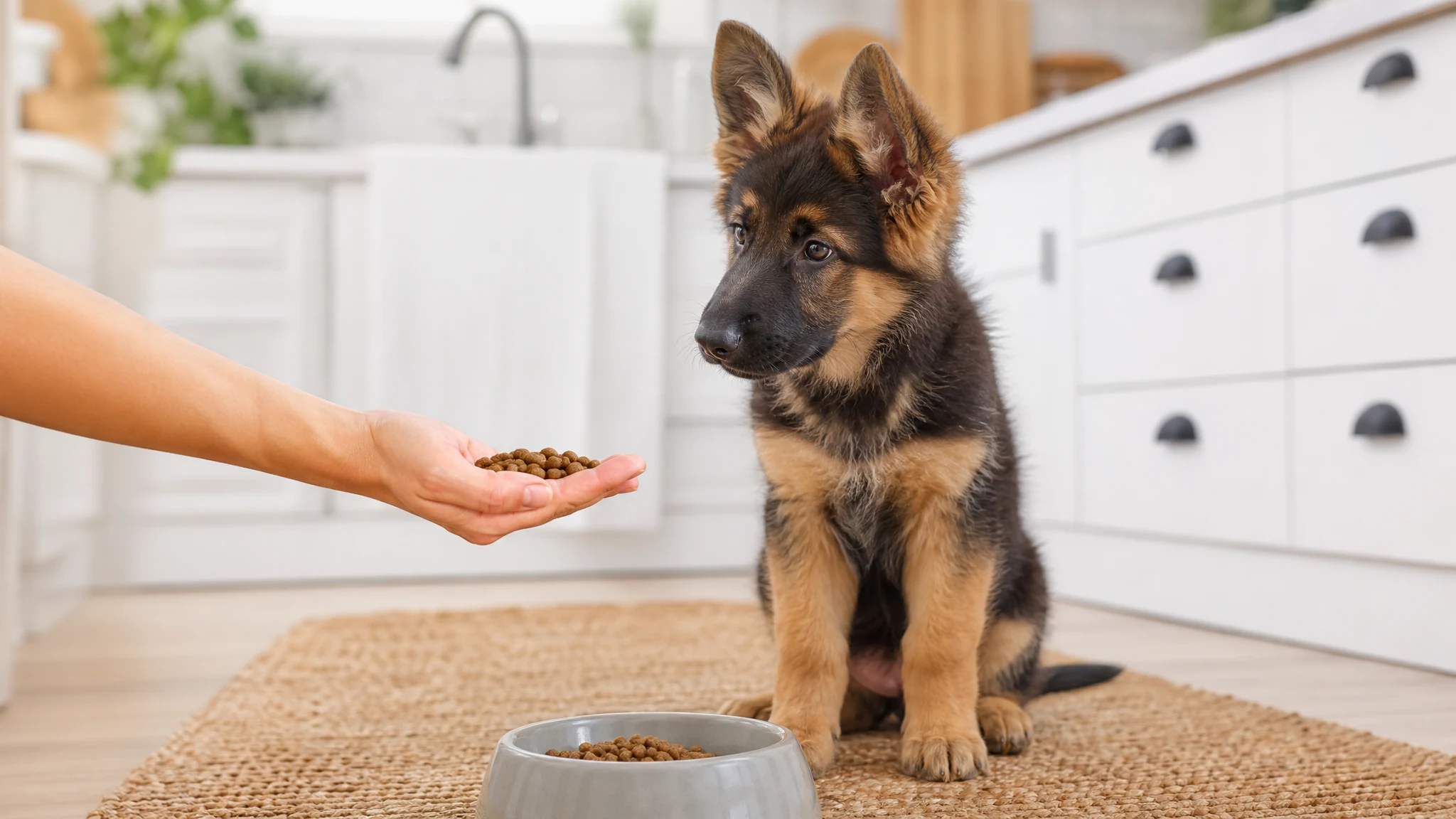
For the first couple of weeks, put a small portion of the meal in your hand and feed it piece by piece. Then place the bowl down with the rest.
This teaches the puppy that a hand near the food means more food, not loss. It also gives you a close look at how your puppy handles being touched while eating.
Step 5. Practice "approach and add"
While your puppy eats from the bowl, walk past at a distance that causes no reaction. Toss a treat into the bowl as you pass, then keep walking. Over days, pass closer.
The lesson is simple. A person approaching is the signal for something even better to arrive. Do not stand over the puppy or reach in with an empty hand early on.
Step 6. Teach trading up
Once the puppy is comfortable with approach and add, practice trades. Offer a treat that is clearly better than what the puppy has, such as a chew or a piece of food. As the puppy lets go and comes to the treat, say your cue word, give the treat, and then often hand the original item back.
Give things back often. If a trade always ends with the puppy losing something, trades start to feel like theft. If they usually end with a reward and the item returned, the puppy learns to let go willingly.
Step 7. Slow down a gulper
If your German Shepherd puppy is eating too fast, change how the food is delivered:
- Use a slow feeder bowl with ridges or obstacles.
- Spread kibble over a snuffle mat or in the cups of a muffin tin.
- Scatter a small portion on a clean floor or in the grass for a short forage.
- Feed part of the meal by hand as a training game.
Do not put large rocks or objects in a bowl. A puppy could swallow them. Choose products made for the purpose and watch the first few meals.
Fast eating by itself is common. But if your puppy is losing weight despite a normal or big appetite, or has abnormal stools, tell your veterinarian. Hill's lists exocrine pancreatic insufficiency as a recognized condition in the breed, and only a veterinarian can sort that out.
Step 8. Turn meals into short training sessions
Use part of each meal for practice: sit, down, "leave it," and "wait." A puppy who works for a few pieces of kibble eats more slowly and learns that food comes with calm behavior.
Keep sessions to a couple of minutes. End while the puppy is still interested.
Tips for success
- Stay low-key. Speak softly, move slowly, and keep your body relaxed.
- Involve the family. Everyone should follow the same routine. Children should only practice with an adult standing next to them.
- Keep treats better than the bowl. The trade only works if the puppy wants what you are offering.
- Handle the bowl without a fuss. Occasionally pick up the empty bowl, add something tasty, and return it.
- Watch growth, not just manners. Hill's says puppy formulas with controlled calcium and phosphorus support skeletal development, and the Whole Dog Journal says too much calcium can be a problem for large-breed puppies. Check that the adequacy statement on your food says "including growth of large size dogs (70 lb. or more as an adult)."
Common mistakes to avoid
- Taking the bowl away mid-meal. This teaches the puppy that people at the bowl are a threat. It can create the very behavior you are trying to prevent.
- Punishing a growl. A growl is communication. If you punish it, the puppy may stop warning you and go straight to a snap. Back off, stay calm, and make a plan for the next meal.
- Using confrontation methods. Alpha rolls, scruffing, and other dominance techniques are not recommended by AVSAB. They raise fear and can make guarding worse.
- Feeding one big meal. This adds to the gulping problem and, per Merck, is a listed bloat risk factor.
- Crowding the puppy. Putting several pets or children around one bowl invites competition.
- Rushing the steps. Move to the next stage only after the puppy is relaxed at the current one.
- Ignoring pain. A puppy that suddenly guards, or flinches when touched near the mouth or belly, may be uncomfortable. Mention it to your veterinarian.
Reading the warning signs
Mild signs include eating faster when you approach, turning the body to block the bowl, or freezing. More serious signs are stiffening, a hard stare, lip lifting, growling, snapping, or biting.
Mild signs can often be handled with the steps above. Serious signs need more help than a how-to article can give.
When to call a professional
Contact your veterinarian if your puppy growls, snaps, or bites over food, toys, or other items, or if the behavior is getting worse. They can check for medical causes and may refer you to a veterinary behaviorist.
You can also look for a trainer who uses only reward-based methods and who is open about how they work. Ask what tools and techniques they use. Avoid anyone who relies on shock, prong, or choke collars, or on dominance methods.
Until you have help, manage the situation. Feed the puppy alone behind a gate, keep children away from the dog during meals, and skip any step that triggers a reaction.
What to expect
Every puppy is different, so no timeline is certain. Many puppies who have never had a bad experience at the bowl relax quickly with these habits. Puppies with a more intense history may take weeks or longer, and some need professional help.
With steady practice, you may see a puppy who sits for meals, eats a bit more slowly, and accepts a person nearby without tension. Treat any progress as a good sign, not a guarantee.
Keep practicing as your puppy grows. Mealtime manners can slip during adolescence, so a few short refreshers now and then help.