When to Switch a German Shepherd Puppy to Adult Food, and How to Make the Change
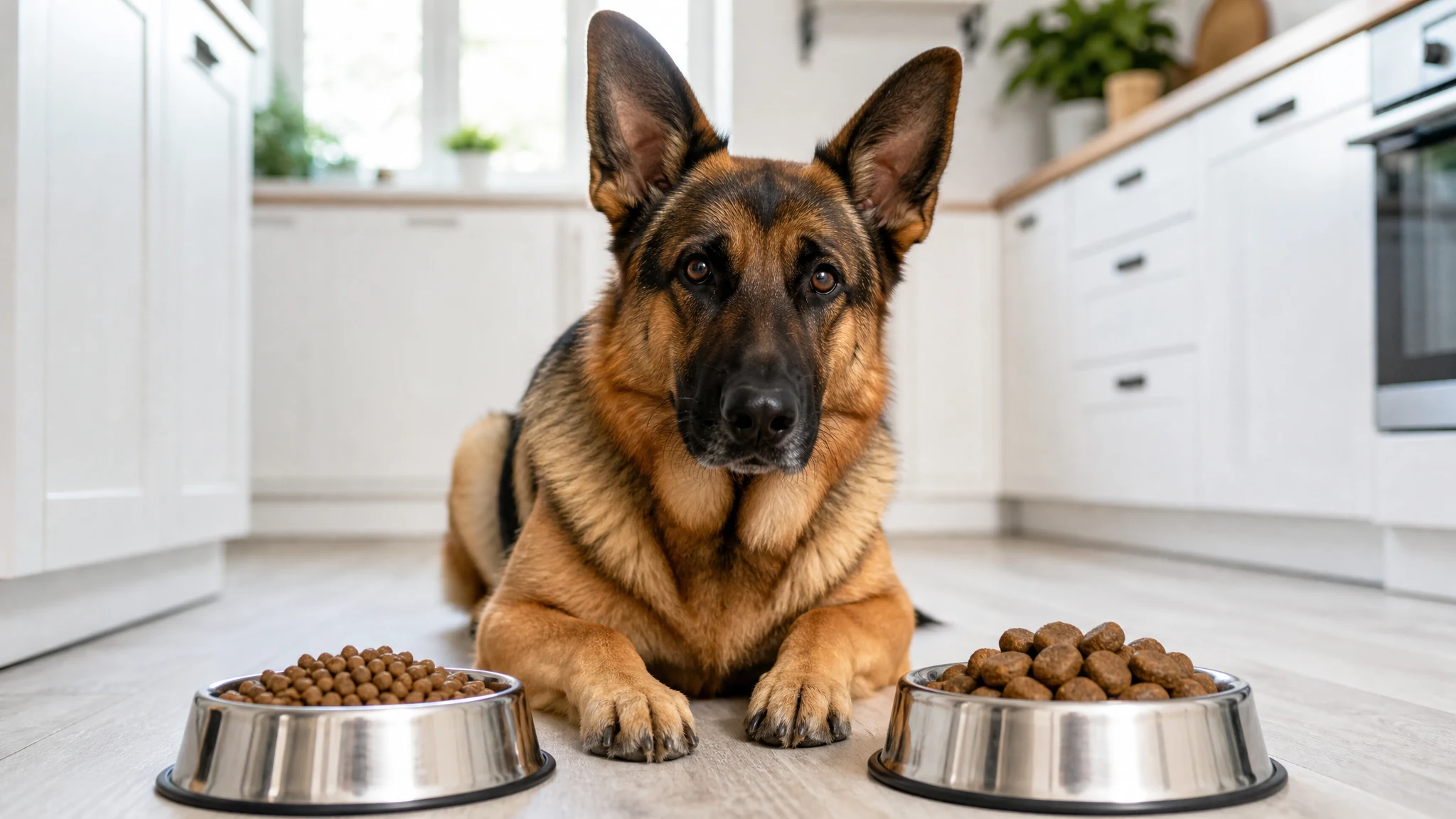
General nutrition information compiled from product labels and published sources, not veterinary advice. Your veterinarian is the right person to choose a diet for your dog, especially one with a health condition.
Most owners ask the same thing around the first birthday: is it time for adult food yet? For a German Shepherd, the honest answer is that no single month is on record. The breed club, the nutrition brands and the regulators we read do not name one.
What they do give us is a set of label clues, a few growth facts and a sensible way to make the change. This guide walks through all three, so you can decide with your veterinarian instead of by calendar alone.
What the sources say about timing
The German Shepherd Dog Club of America does not publish a month for moving off puppy food. Hill's Pet Nutrition, on its German Shepherd breed page, lists the German Shepherd as a large breed and gives an adult weight of roughly 50 to 90 pounds, with males heavier. It does not give a switch age for the breed either.
Hill's food navigation does list the adult life stage as starting at 12 months, but that is a general range for all dogs, not a German Shepherd rule. Large breeds are commonly kept on growth food longer than small ones. No source we opened put a month figure on it for this breed.
So when someone asks how long to feed puppy food to a German Shepherd, the careful answer is: it depends on the individual dog and the formula, and your veterinarian is the person to set the date. Treat 12 months as a point to start the conversation, not a deadline.
Brands also differ on how long their puppy formulas are meant to be fed. The Royal Canin German Shepherd Puppy page, for example, gives daily feeding amounts for ages 2 to 12 months. Check the age range on the product page of the food you are using, because that range is the brand's own statement.
Why the formulas differ: the label clues
Three things change between a growth formula and an adult one. You can see all three on the bag.
1. The AAFCO adequacy statement
Every complete dog food carries a statement naming the life stage it was formulated for. A puppy food says it meets the AAFCO Dog Food Nutrient Profiles for growth. An adult food says maintenance.
Since the 2016 AAFCO change, growth and all life stages foods must also say whether they cover large dogs. The wording is either "including growth of large size dogs (70 lb. or more as an adult)" or "except for growth of large size dogs." Kentucky's administrative regulation 012 KAR 003:039 mirrors that rule. German Shepherd puppies can reach or approach 70 pounds, so the "including" wording is the one to look for.
Some foods are labeled for all life stages, including growth of large size dogs. That means the same bag meets the profile for both a growing large puppy and an adult. If you feed one of these, there may be no formula change to make at all. There may only be a portion change. Ask your veterinarian which approach suits your dog.
2. Calcium and phosphorus
Hill's says puppy formulas with controlled calcium and phosphorus support skeletal development. Whole Dog Journal adds that too much calcium can cause bone and joint abnormalities in large breed puppies, and it defines the large breed cutoff as dogs likely to mature at more than 70 pounds.
We could not verify the exact calcium limits in the AAFCO tables, so we will not quote percentages here. The practical point is that foods meeting the large size growth profile are built with this in mind. A plain "growth" food that says "except for growth of large size dogs" is not the one for a German Shepherd puppy.
3. Calories per cup
Puppy foods are usually more energy dense, but the label is the only reliable guide. These are the calories per cup listed by each brand for a few dry puppy formulas:
| Food (dry) | Calories per cup, as listed |
|---|---|
| Royal Canin German Shepherd Puppy | 331 kcal ME, calculated |
| Hill's Science Diet Puppy Large Breed Lamb Meal & Brown Rice | 378 kcal |
| VICTOR Hi-Pro Plus Large Breed Puppy | 365 kcal |
| Hill's Science Diet Puppy Large Breed Chicken & Brown Rice | 387 kcal |
The spread shows why a cup of one brand is not a cup of another. When you move to an adult formula, read its calories per cup and compare them to your puppy food. Do not assume the numbers drop.
If you want the label comparison for puppy foods in full, see our label-by-label comparison of puppy foods for German Shepherds. We compared label data only. We did not run feeding trials or taste tests.
Why weight matters for this breed
The Orthopedic Foundation for Animals says calorie intake is an environmental factor in hip dysplasia, and that keeping a dog from becoming overweight reduces mechanical stress on the hips. Hill's lists German Shepherds as prone to developmental joint disorders.
That is why timing is about more than the bag. A dog that stays on rich growth food well past the point of need, with no change to portions, can gain extra weight. Food does not prevent or treat joint disease, and your veterinarian decides what is right for an individual dog. But keeping a lean body shape is a goal worth discussing at the switch.
What you need
- The new adult food, in a bag large enough for about two weeks.
- Your current puppy food, so you do not run out mid-change.
- Both labels, kept or photographed, for the adequacy statements and calories per cup.
- A standard measuring cup or kitchen scale, used the same way every meal.
- A notebook or phone note for weight, stool and appetite observations.
- An appointment or call with your veterinarian before you start.
Step by step: making the change
Step 1. Talk to your veterinarian first
Ask three things. Is my puppy's body condition on track? Is it time to move off growth food, or is an all life stages formula that includes large size growth a better fit? What should the starting portion be?
Your veterinarian can weigh the dog and feel its ribs and waist. A label cannot do that. Bring the bag.
Step 2. Choose the new food by its label
Read the adequacy statement first. For an adult formula, look for the maintenance wording, or for an all life stages food, the "including growth of large size dogs" line. Then check the first ingredients and the calories per cup.
Be cautious with marketing words like "ancestral" or "premium." They are not label standards. If you are looking at a grain-free food, know that the FDA's last public update on its diet and dilated cardiomyopathy investigation was dated December 23, 2022. The FDA has not established a causal link between specific diets and DCM. Ask your veterinarian if you have questions about it for your dog.
Step 3. Pick a calm start date
Avoid vaccination days, boarding, travel, a move or a heat spike. A quiet week gives you cleaner observations.
Step 4. Mix the old and new food over 7 to 10 days
Hill's, on its large breed puppy product page, advises switching gradually over 7 days. A slower 10 day change is reasonable for a dog with a sensitive stomach. Here is a simple pattern:
- Days 1 to 2 (or 3): about one quarter new food, three quarters old.
- Days 3 to 5 (or 4 to 6): about half and half.
- Days 6 to 7 (or 7 to 8): about three quarters new, one quarter old.
- Day 8 (or 9 to 10): all new food.
These are mixing proportions, not feeding amounts. The total volume per meal is your starting portion from step 5.
Step 5. Set the starting portion from the label guide
Use the feeding guide on the new bag as a starting point, matched to your dog's current weight and expected adult weight. Hill's notes that you should adjust amounts as necessary to maintain optimal weight, and to ask your veterinarian if unsure.
Because calories per cup differ between foods, the same cup count can mean more or fewer calories. Recheck against your veterinarian's advice.
Step 6. Keep meals split and slow
The Merck Veterinary Manual lists German Shepherd Dogs as an at-risk breed for gastric dilatation and volvulus (bloat). It names once-daily feeding, dry kibble only and fast eating as risk factors, and advises multiple small meals. Most owners keep two meals a day after the switch.
If your dog gulps, ask your veterinarian about slowing options. Do not rely on any food to prevent bloat.
Step 7. Track the dog for two to four weeks
Check stool quality, appetite, energy and body shape once a week. Weigh at home if you can, or visit your veterinarian's scale.
Expected results
Many dogs adjust within the transition window with no fuss. You may see slightly softer stool for a few days, which often settles as the mix shifts. Coat, energy and appetite usually stay steady if the new food suits the dog.
Results vary by dog. Nothing here is a promise, and a food change does not treat any condition.
Signs the switch came too early or too late
Possibly too early
- The dog is losing weight or looks thin through the ribs and hips at the same portion.
- The dog seems hungry after meals and low in energy.
- Your veterinarian says the dog is still growing quickly and wants growth food kept longer.
Weight loss with a normal appetite, along with abnormal stools, is also listed by Hill's as a sign of exocrine pancreatic insufficiency, a condition the breed is known for. That is a veterinary matter, not a food-brand problem. Call your veterinarian rather than adjusting the diet on your own.
Possibly too late
- The waist is disappearing and ribs are hard to feel.
- Weight is climbing at a steady portion.
- The dog is past the age your veterinarian suggested for the change.
Given what the OFA says about weight and hip stress, a growing waistline is worth a prompt portion review.
Common mistakes to avoid
- Switching all at once. A sudden change often means loose stools and a stressed owner.
- Choosing by the calendar only. A date on a calendar tells you less than your dog's body condition.
- Picking a general growth food. If the statement says "except for growth of large size dogs," it is not meant for a German Shepherd puppy.
- Keeping the same cup count. Calories per cup differ, so recheck the portion.
- Adding supplements to "help." Extra calcium can work against a large breed puppy's balanced diet. Ask your veterinarian before adding anything.
- Changing food and routine together. Move one thing at a time.
When to call your veterinarian
Call if loose stool lasts more than a couple of days, if the dog vomits or refuses food, or if you see a swollen belly or unproductive retching. Those last two need urgent attention.
Sources
- Hill's Pet Nutrition, German Shepherd breed page
- Hill's Science Diet, Puppy Large Breed Lamb Meal & Brown Rice product page
- Hill's Science Diet, Puppy Large Breed Chicken & Brown Rice product page
- Royal Canin, German Shepherd Puppy product page
- VICTOR, Hi-Pro Plus Large Breed Puppy product page
- German Shepherd Dog Club of America, About the breed
- Orthopedic Foundation for Animals, Hip Dysplasia
- Merck Veterinary Manual, Gastric Dilation and Volvulus in Small Animals
- Whole Dog Journal, In the Fine Print: Nutritional Adequacy Statements
- Kentucky Administrative Regulations, 012 KAR 003:039
- FDA Center for Veterinary Medicine, investigation into diets and canine dilated cardiomyopathy