Royal Canin German Shepherd Puppy Food vs Large-Breed Puppy Formulas
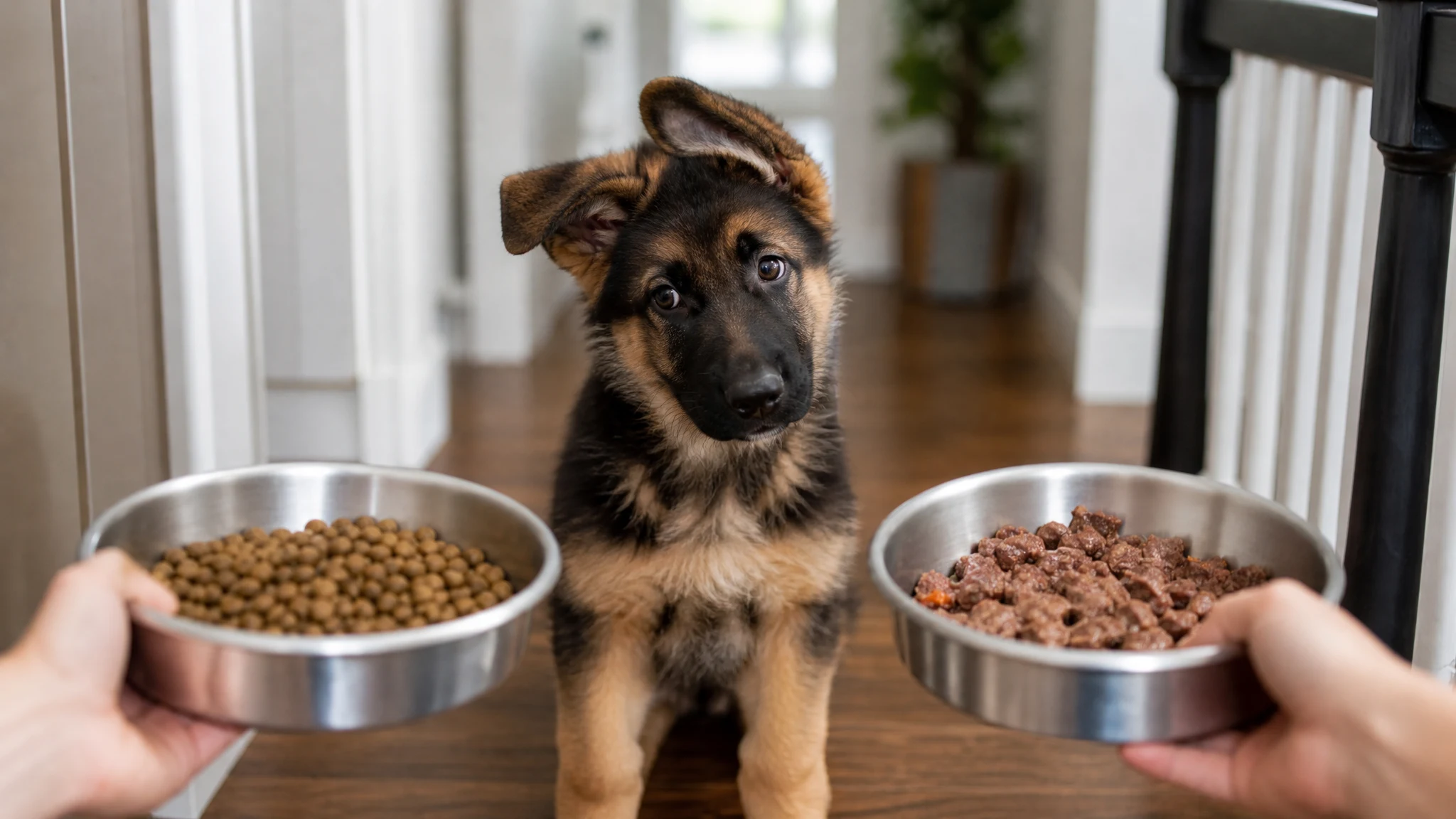
General nutrition information compiled from product labels and published sources, not veterinary advice. Your veterinarian is the right person to choose a diet for your dog, especially one with a health condition.
Choosing a growth food for a German Shepherd puppy means sorting breed-named bags from size-named bags. Royal Canin German Shepherd Puppy is one of the few formulas sold for this breed by name. Hill's and VICTOR sell large-breed puppy formulas that do not name the breed.
This guide shows you how to compare them yourself, one label at a time. We compared label data only. We did not run feeding trials or taste tests, and we are not saying any food is better for your dog.
Why the comparison matters for this breed
The German Shepherd Dog Club of America is the parent breed club. Hill's Pet Nutrition lists the breed as large, with adults of roughly 50 to 90 pounds, and males run heavier. A puppy that ends up near the top of that range is growing fast for months.
Hill's says puppy formulas with controlled calcium and phosphorus support skeletal development. Whole Dog Journal says too much calcium can cause bone and joint abnormalities in large-breed puppies. It defines the large-breed cutoff as dogs likely to mature at more than 70 pounds. That is why the label wording matters more than the picture on the bag.
The Orthopedic Foundation for Animals (OFA) says calorie intake is an environmental factor in hip dysplasia. It also says keeping a dog from becoming overweight reduces stress on the hips. A food cannot prevent or treat a joint disorder. A veterinarian decides what suits an individual puppy.
Materials you will need
- The bag or the brand's product page for each food you are considering.
- A notepad or spreadsheet with one row per food.
- Your puppy's current weight and age.
- A standard measuring cup, so you can turn label cup amounts into real portions.
- Your veterinarian's contact details, because the final call is theirs.
Step 1: Find the adequacy statement
Every complete food carries a statement from the Association of American Feed Control Officials (AAFCO). It says either that the food was formulated to meet the AAFCO nutrient profiles or that feeding tests substantiate it.
For a growth or all life stages food, the statement should end with one of two phrases. One says the food is for growth "including growth of large size dogs (70 lb. or more as an adult)." The other says "except for growth of large size dogs (70 lb. or more as an adult)." Kentucky's regulation 012 KAR 003:039 mirrors this AAFCO rule. Whole Dog Journal recommends the "including" wording for large-size puppies.
A German Shepherd puppy can reach or approach 70 pounds, so look for "including." Here is what the brand pages say:
- Royal Canin German Shepherd Puppy: formulated to meet the AAFCO profiles for growth including growth of large size dogs.
- VICTOR Hi-Pro Plus Large Breed Puppy: formulated for all life stages, including growth of large size dogs.
- Hill's Science Diet Puppy Large Breed (Chicken & Brown Rice): feeding tests using AAFCO procedures substantiate it for growing puppies. The page text we have does not show the large-size wording, so read the full statement on the bag or the Hill's page.
- Hill's Science Diet Puppy (Chicken & Brown Rice): the standard puppy recipe, not a large-breed one. It is also cleared for gestating or lactating females.
Step 2: Check whether the formula is breed-specific, size-specific or general
Write down which of three groups each food belongs to.
- Breed-specific: Royal Canin German Shepherd Puppy.
- Large-breed puppy: Hill's Science Diet Puppy Large Breed in chicken or lamb meal recipes, and VICTOR Hi-Pro Plus Large Breed Puppy.
- General or all life stages: Hill's Science Diet Puppy, VICTOR Grain Free Active Dog & Puppy, and the fresh foods from Nom Nom, Freshpet and JustFoodForDogs.
The general foods are not wrong by default. Several carry the "including growth of large size dogs" wording. The point is to know what the maker designed the food for. A food sold as a large-breed puppy formula tells you the maker had large puppies in mind. A general food leaves that to the adequacy statement.
Royal Canin's page says the kibble shape, size and texture are adapted to the German Shepherd puppy. It gives no dimensions, so we cannot tell you the size in millimeters. None of the brand pages we reviewed give kibble dimensions.
Step 3: Read the first ingredients
Ingredients are listed by weight before cooking. The first five give a rough picture, nothing more. Here they are as the brands list them.
| Food | First five ingredients |
|---|---|
| Royal Canin German Shepherd Puppy | Chicken by-product meal, corn, wheat gluten, oat groats, brewers rice |
| Hill's Puppy Large Breed, Chicken & Brown Rice | Chicken, brown rice, whole grain oats, chicken meal, cracked pearled barley |
| Hill's Puppy Large Breed, Lamb Meal & Brown Rice | Lamb meal, brown rice, cracked pearled barley, whole grain oats, chicken fat |
| VICTOR Hi-Pro Plus Large Breed Puppy | Chicken, chicken meal, brown rice, whole grain millet, whole grain sorghum |
Be skeptical of reading too much into this. "Chicken" listed first contains a lot of water, so a meal can supply more protein after cooking than its position suggests. A by-product meal is not automatically worse than a named meat. It is a different ingredient, and the label does not say how the food performs.
Royal Canin lists corn and wheat gluten early. VICTOR's large-breed recipe leads with chicken and chicken meal. These are facts about the recipe. They are not a ranking. A puppy with a known food sensitivity should have the ingredient list checked by your vet.
Step 4: Compare protein, fat and fiber the same way
This step is where people most often make mistakes. Brands report the guaranteed analysis on different bases.
- Royal Canin lists minimums as fed: protein 28.0%, fat 14.0%, fiber at most 3.9%.
- VICTOR Hi-Pro Plus Large Breed Puppy lists protein 30% minimum, fat 14.0% minimum, fiber at most 6.0%.
- The Hill's pages we reviewed list dry-matter figures only. For the chicken large-breed recipe that is protein 26.7%, fat 15.4% and fiber 2.8%. For the lamb recipe it is protein 28.1%, fat 17.8% and fiber 2.7%.
Do not put a dry-matter number next to an as-fed minimum and call one higher. They are not the same measurement. Hill's as-fed guaranteed analysis was not available to us, so check the bag or ask the brand.
Also remember that these are minimums and maximums, not exact amounts. They describe a floor or a ceiling for each nutrient.
Step 5: Look for calcium and phosphorus
This is the data point that matters most for a large puppy, and it is the hardest to compare from public pages. Many bags list a calcium minimum and maximum in the guaranteed analysis. Phosphorus is often shown too. The ratio is simply calcium divided by phosphorus.
We did not have verified calcium and phosphorus numbers for these foods, so we are not printing any. We also cannot give you a verified numeric calcium limit for large-size growth foods. What we can say is that large-size growth foods are held to a lower calcium ceiling than other growth foods. Check each bag or ask the brand for the figures, and add them to your notepad.
If a brand will not give you calcium and phosphorus numbers, that is useful information in itself. Ask your veterinarian whether the food suits your puppy.
Step 6: Compare calories and portions
Calories per cup tell you how fast a puppy gains weight on a given scoop. The pages list:
- Royal Canin German Shepherd Puppy: 331 kcal ME per cup, calculated.
- Hill's Puppy Large Breed Chicken & Brown Rice: 387 kcal per cup.
- Hill's Puppy Large Breed Lamb Meal & Brown Rice: 378 kcal per cup.
- VICTOR Hi-Pro Plus Large Breed Puppy: 365 kcal per cup.
The same cup of a denser food delivers more energy. Swapping foods cup for cup can change how much your puppy eats without you noticing. That matters because OFA ties keeping a dog lean to lower stress on the hips.
Royal Canin's page gives daily amounts by puppy age from 2 to 12 months and by expected adult weight of 57, 77 or 97 pounds. VICTOR gives a feeding chart in cups per day by age and weight, based on a standard 8 oz. measuring cup. Hill's tells you to adjust amounts to maintain optimal weight, and to ask your veterinarian if you are unsure.
Treat every chart as a starting point. Weigh your puppy regularly and ask your veterinarian to check body condition.
Step 7: Think about the grain-free and fresh options
VICTOR Grain Free Active Dog & Puppy lists beef meal, peas, garbanzo beans, chicken fat and sweet potatoes first. Its label says it is formulated for all life stages, including growth of large size dogs.
The U.S. Food and Drug Administration (FDA) has investigated a possible link between certain diets and canine dilated cardiomyopathy (DCM). Its most recent public update is dated December 23, 2022. FDA says it has not established a causal link between specific diets and DCM. It does not plan further public updates until there is meaningful new scientific information. Do not take that as a warning about any one food or as clearance for it. If you are weighing a grain-free diet, discuss the question with your veterinarian.
Nom Nom, Freshpet and JustFoodForDogs sell fresh foods. Their pages state all life stages wording that includes growth of large size dogs. Nom Nom's Turkey & Chicken Cookout page was only partly captured, so we cannot confirm its full statement or whether it is grain free. Check the brand page for those details. Fresh recipes are not breed-specific, and the Freshpet and JustFoodForDogs pages do not list fixed portions per puppy, so follow each brand's own calculator or guide.
Step 8: Ask about mealtime habits and health risks
The Merck Veterinary Manual lists German Shepherd Dogs as an at-risk breed for gastric dilatation-volvulus (bloat). It names once-daily feeding, dry kibble only and fast eating as risk factors. It advises several small meals. This is general advice for deep-chested breeds and does not mean any one food causes or prevents bloat.
Hill's also notes that the breed has a documented predisposition to exocrine pancreatic insufficiency. Signs include weight loss despite a normal appetite and abnormal stools. If you see those signs, call your veterinarian rather than changing food on your own.
Step 9: Make your shortlist and switch gradually
Put your notes side by side. Keep foods that meet these points:
- An adequacy statement that says growth "including" large size dogs, or a clear answer from the brand.
- Calcium and phosphorus figures you could find and read.
- A calorie count and feeding guide you can follow with a measuring cup.
- An ingredient list with nothing your puppy has reacted to before.
Take the shortlist to your veterinarian. When you choose one, transition slowly. Hill's suggests switching gradually over 7 days, and that is a reasonable pattern for any change.
For a wider comparison across brands, see our label-based comparison of German Shepherd puppy foods.
Tips and common mistakes to avoid
- Buying on the breed name alone. A German Shepherd label is not proof of a better fit. Read the same data you would on any bag.
- Comparing different bases. As-fed and dry-matter numbers are not interchangeable.
- Ignoring the adequacy ending. "Except for growth of large size dogs" is a red flag for this breed.
- Feeding the cup amount on autopilot. Calories per cup vary a lot between foods, and so does a puppy's growth.
- Changing foods too often. Frequent swaps make it hard to tell what is causing a stool or skin change.
- Treating the food as medicine. No bag treats or prevents hip dysplasia, allergies or DCM. Prescription diets come only from a veterinarian.
- Switching to adult food by guesswork. We found no breed-specific month figure for the change. Royal Canin's German Shepherd Puppy page gives feeding amounts through 12 months, and Hill's large-breed puppy recipes run up to 18 months. Ask your veterinarian when to switch.
What to expect
Done carefully, this process may give you a short, well-documented list instead of a pile of marketing claims. A food that meets large-size growth requirements and is fed at sensible portions may support steady growth and a lean body condition. Results vary by puppy, genetics and activity, and no food can promise a particular outcome.
Expect to adjust. Weigh your puppy every couple of weeks, watch stool quality and energy, and report changes to your veterinarian.
Sources
- German Shepherd Dog Club of America, About the breed
- Hill's Pet Nutrition, German Shepherd breed page
- Orthopedic Foundation for Animals, Hip Dysplasia
- Merck Veterinary Manual, Gastric Dilation and Volvulus in Small Animals
- Kentucky Administrative Regulations 012 KAR 003:039
- Whole Dog Journal, In the Fine Print: Nutritional Adequacy Statements
- FDA Center for Veterinary Medicine, investigation into diets and canine DCM
- Royal Canin, German Shepherd Puppy product page
- Hill's Science Diet Puppy Large Breed Chicken & Brown Rice
- Hill's Science Diet Puppy Large Breed Lamb Meal & Brown Rice
- VICTOR Hi-Pro Plus Large Breed Puppy
- VICTOR Grain Free Active Dog & Puppy