Royal Canin German Shepherd Puppy Food: How It Compares on the Label
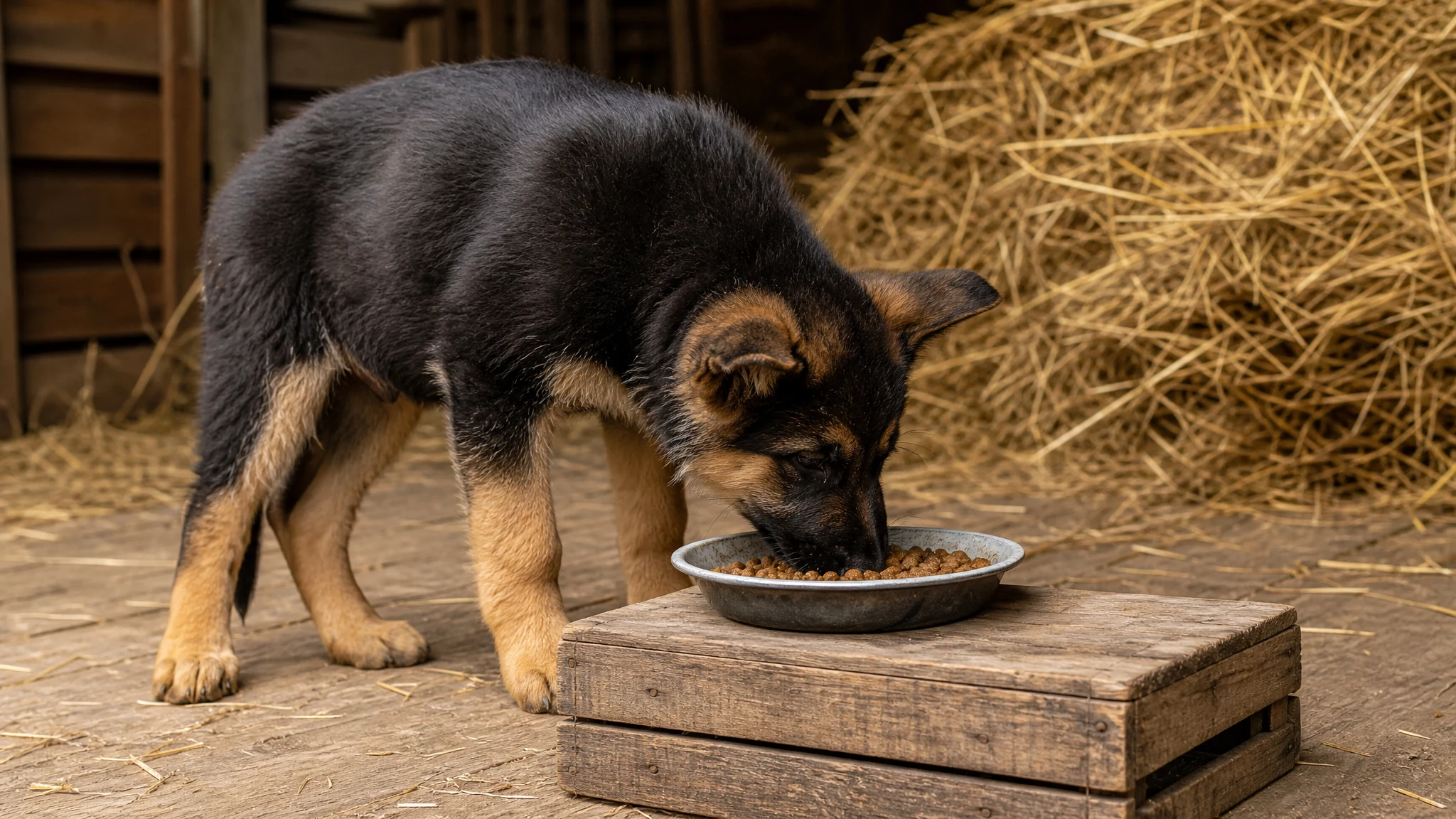
General nutrition information compiled from product labels and published sources, not veterinary advice. Your veterinarian is the right person to choose a diet for your dog, especially one with a health condition.
Royal Canin German Shepherd puppy food is one of the few formulas named for the breed. A breed name on the bag is marketing, though. What matters is what the label says.
This guide shows you how to read that label and set it beside other large-breed puppy foods, step by step. We compared label data from the brands' own pages. We did not run feeding trials or taste tests, and nothing here says a food will prevent or treat any condition.
Why the label matters for a German Shepherd puppy
The German Shepherd Dog Club of America is the parent breed club. Hill's Pet Nutrition lists the breed as large, with adults at roughly 50 to 90 pounds, males heavier. That puts many puppies at or near the 70 pound line that pet food rules use for large-size growth.
Hill's says puppy formulas with controlled calcium and phosphorus support skeletal development. Whole Dog Journal says too much calcium can cause bone and joint abnormalities in large-breed puppies. It defines the large-breed cutoff as dogs likely to mature at more than 70 pounds.
The Orthopedic Foundation for Animals (OFA) says calorie intake is an environmental factor in hip dysplasia. It also says keeping a dog from becoming overweight reduces stress on the hips. So calories and portions matter as much as the brand name. A veterinarian decides what is right for an individual puppy.
Materials you need
- The bag or the brand's own product page for each food you want to compare
- A notepad or spreadsheet with one row per food
- Your puppy's age and current weight
- Your breeder's or veterinarian's advice on target adult size
- A list of questions to ask your veterinarian
Step 1: Find the adequacy statement
Look for a sentence that starts with something like "formulated to meet the nutritional levels established by the AAFCO Dog Food Nutrient Profiles." It usually sits in small print near the guaranteed analysis.
Check three things:
- Does it say growth or all life stages? A food for adult maintenance only is not a puppy food.
- Does it say how the food was substantiated? Some say "formulated to meet," which means a nutrient profile. Others say "animal feeding tests using AAFCO procedures," which means a feeding trial was run by the maker.
- How does the sentence end? This is the most important part for your puppy.
Step 2: Check the large-size growth wording
Since the 2016 AAFCO change, a food claiming growth or all life stages must end its statement one of two ways. Kentucky's regulation 012 KAR 003:039 mirrors the rule.
- "including growth of large size dogs (70 lb. or more as an adult)" means the food meets the large-size growth nutrient levels.
- "except for growth of large size dogs (70 lb. or more as an adult)" means it does not.
German Shepherd puppies can reach or approach 70 pounds, so Whole Dog Journal recommends looking for the "including" wording. Royal Canin's page says its German Shepherd Puppy formula meets the AAFCO profiles for growth including growth of large size dogs (70 lb. or more as an adult). If a food says "except," set it aside for a German Shepherd puppy.
Step 3: Read protein, fat and fiber carefully
The guaranteed analysis lists minimum protein and fat and maximum fiber. These are floors and ceilings, not exact amounts. They are also "as fed," meaning they include the water in the food.
Some brands, such as Hill's on its product pages, list dry-matter figures instead. Those numbers run higher than as-fed numbers for the same food. Never put a dry-matter figure next to an as-fed figure and call one richer. In the table below they sit in separate rows for that reason.
Step 4: Read the first five ingredients
Ingredients are listed by weight before cooking. The first five tell you the main building blocks. They do not tell you quality, and a long list does not prove a better food.
Note whether the first item is a named meat, a meal or a by-product meal. Note the grains or legumes that follow. Ask what each does in the recipe rather than assuming a word on the bag means good or bad.
Step 5: Note calories per cup
Calories per cup tell you how much a cup will contribute to your puppy's day. A denser food needs a smaller scoop. This is where portion control starts, and it is why OFA's point about avoiding excess weight is practical for your feeding scoop.
Step 6: Ask about calcium and phosphorus
Many bags do not print calcium and phosphorus in a way that lets you work out a ratio. Some brands publish them on their product page or on request. We did not find a verified figure for the foods below, so we do not list one.
Ask the brand directly for the calcium and phosphorus levels and the ratio, then take the numbers to your veterinarian. A large-size growth statement already tells you the food was designed with the large-breed calcium limits in mind.
Step 7: Put the foods side by side
Here is how the label data compares for Royal Canin German Shepherd puppy food and several other formulas that state growth or large-size growth. The data comes from each brand's own product page.
| Food | Growth wording | Protein min / fat min / fiber max | Calories per cup | First five ingredients |
|---|---|---|---|---|
| Royal Canin German Shepherd Puppy (dry) | Growth including large size dogs (70 lb. or more) | 28% / 14% / 3.9% | 331 kcal ME, calculated | Chicken by-product meal, corn, wheat gluten, oat groats, brewers rice |
| VICTOR Hi-Pro Plus Large Breed Puppy (dry) | All life stages including growth of large size dogs | 30% / 14% / 6.0% | 365 kcal | Chicken, chicken meal, brown rice, whole grain millet, whole grain sorghum |
| VICTOR Grain Free Active Dog & Puppy (dry) | All life stages including growth of large size dogs | 33% / 16% / 3.8% | 384 kcal | Beef meal, peas, garbanzo beans, chicken fat, sweet potatoes |
| Hill's Science Diet Puppy Large Breed Chicken & Brown Rice (dry) | Animal feeding tests using AAFCO procedures, growing puppies | Dry matter: 26.7% protein / 15.4% fat / 2.8% fiber | 387 kcal | Chicken, brown rice, whole grain oats, chicken meal, cracked pearled barley |
| Hill's Science Diet Puppy Large Breed Lamb Meal & Brown Rice (dry) | Animal feeding tests using AAFCO procedures, growing puppies | Dry matter: 28.1% protein / 17.8% fat / 2.7% fiber | 378 kcal | Lamb meal, brown rice, cracked pearled barley, whole grain oats, chicken fat |
Kibble size is not given in numbers by any of these brands, so we cannot compare it. Royal Canin says only that the shape, size and texture are adapted to the German Shepherd puppy.
What the table does and does not show
Royal Canin lists a lower protein minimum than the two VICTOR foods, and the lowest calories per cup of the group. Its first ingredient is a by-product meal and corn and wheat gluten follow. VICTOR Hi-Pro Plus leads with chicken and chicken meal and has a higher fiber ceiling.
Neither of those facts makes one food better. They show how the recipes differ. The Hill's rows use dry-matter numbers, so compare them only with each other.
Royal Canin's page gives daily feeding amounts by puppy age from 2 to 12 months and by target adult weight of 57, 77 or 97 pounds. That is useful for a breed with a wide adult weight range. Treat those amounts as starting points and check the brand's page for the current chart.
Step 8: Handle grain-free labels with care
VICTOR's Grain Free Active Dog & Puppy lists peas and garbanzo beans among its first ingredients. If you see a grain-free formula, know the current status of the FDA investigation into diet and canine dilated cardiomyopathy (DCM).
The FDA's latest public update is dated December 23, 2022. The agency said it has not established a causal link between specific diets and DCM. It also said it does not plan more public updates until there is meaningful new scientific information. Do not treat grain-free as either dangerous or protective. Ask your veterinarian whether it fits your puppy.
Step 9: Decide on feeding amounts and schedule
Use the brand's chart as a starting point, then adjust with your veterinarian as your puppy grows and body condition changes. Hill's notes on its pages that you should adjust amounts to maintain a healthy weight and ask a veterinarian if unsure.
The Merck Veterinary Manual lists German Shepherd Dogs as an at-risk breed for gastric dilatation-volvulus (bloat). It names once-daily feeding, dry kibble only and fast eating as risk factors, and advises several small meals. Ask your veterinarian how to split your puppy's day.
Tips
- Compare one column at a time, so you do not mix as-fed and dry-matter numbers.
- Write down the exact product name. Brands often sell a puppy, a large-breed puppy and an adult version that look alike.
- Check the brand's own page for the current label. Recipes can change.
- If you switch foods, Hill's advises doing it gradually over 7 days on its lamb formula page. That is a reasonable pattern to bring to your veterinarian.
- Weigh your puppy's food rather than guessing with a scoop, if your veterinarian agrees.
Common mistakes to avoid
- Trusting the breed name alone. Read the adequacy statement even when the bag says German Shepherd.
- Buying an adult or "except for large size" food. Check the closing words of the AAFCO sentence.
- Judging by protein alone. Higher protein is not automatically better for growth. Calories and calcium matter too.
- Feeding to the bag without watching the puppy. Body condition is the guide, and the chart is the starting point.
- Using supplements to "fix" a food. Extra calcium is the opposite of what large-breed puppy formulas are built for. Ask your veterinarian before adding anything.
- Asking food to manage a health issue. Conditions seen in the breed, such as hip and elbow dysplasia or exocrine pancreatic insufficiency (EPI), are for a veterinarian to diagnose and manage. Prescription diets are something only a veterinarian prescribes.
What to expect
Done well, this comparison should leave you with a short list of foods that carry the right large-size growth wording. You should also understand how their protein, fat, fiber, calories and first ingredients differ.
It may help you talk with your veterinarian about portions and meal timing. It will not tell you how your puppy will do on a given food, since label data cannot show that. Watch your puppy's weight, energy and stools, and report changes to your veterinarian.
Next step
For a wider look at more formulas, including fresh and other options, see our label comparison of the best food for German Shepherd puppies.
Sources
- Royal Canin, German Shepherd Puppy product page
- VICTOR, Hi-Pro Plus Large Breed Puppy
- VICTOR, Grain Free Active Dog & Puppy
- Hill's Science Diet Puppy Large Breed Chicken & Brown Rice
- Hill's Science Diet Puppy Large Breed Lamb Meal & Brown Rice
- Hill's Pet Nutrition, German Shepherd breed page
- German Shepherd Dog Club of America, About the breed
- Orthopedic Foundation for Animals, Hip Dysplasia
- Merck Veterinary Manual, Gastric Dilation and Volvulus in Small Animals
- FDA CVM, Investigation into Potential Link between Certain Diets and Canine Dilated Cardiomyopathy
- Kentucky Administrative Regulations, 012 KAR 003:039
- Whole Dog Journal, In the Fine Print: Nutritional Adequacy Statements