Dry, Wet and Fresh Puppy Food for German Shepherd Puppies: What the Labels Say
General nutrition information compiled from product labels and published sources, not veterinary advice. Your veterinarian is the right person to choose a diet for your dog, especially one with a health condition.
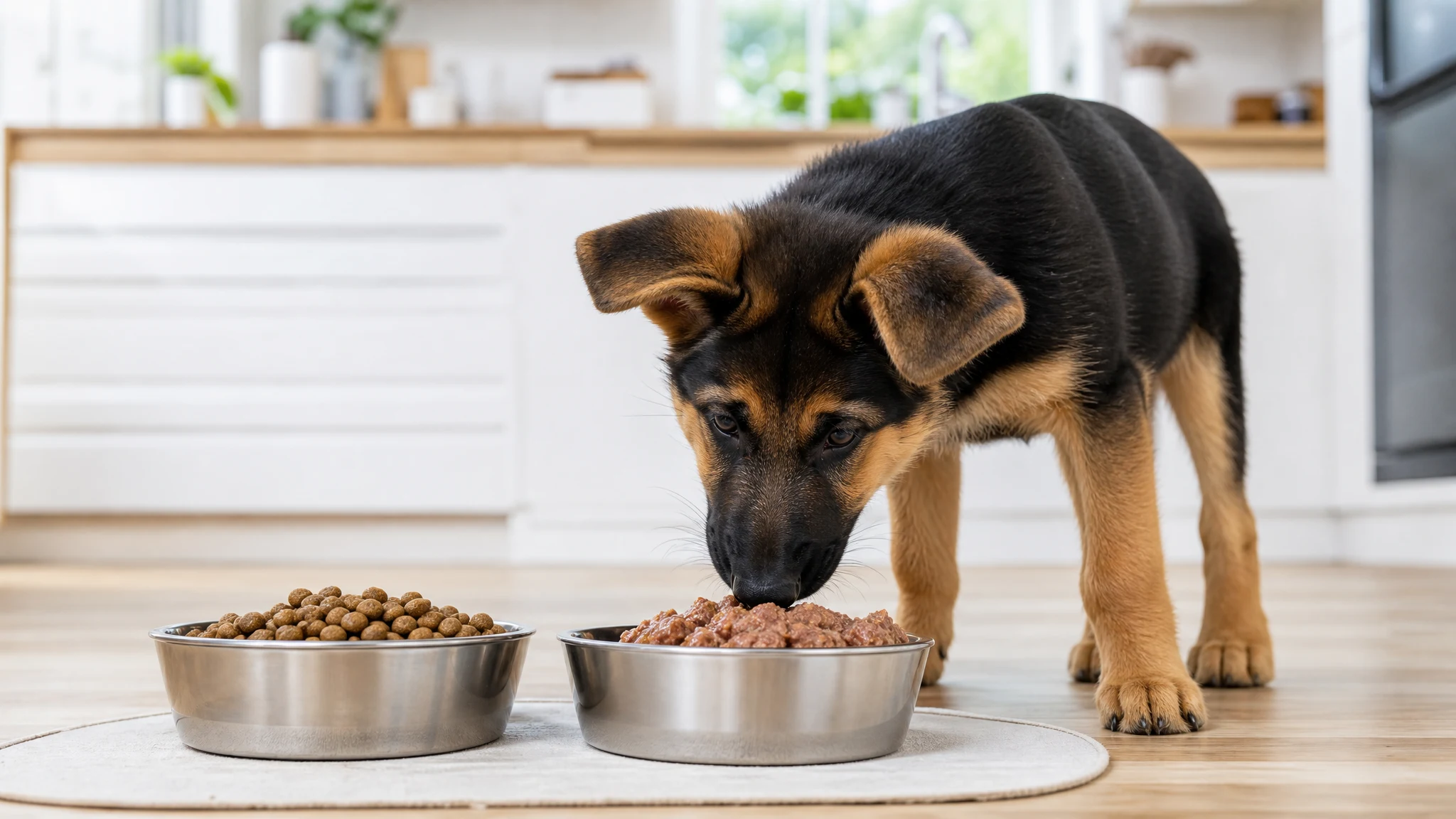
Dry kibble, canned wet food and refrigerated fresh food all show up in the puppy aisle. Each one claims to be the right choice for a big, fast-growing dog. This page compares them for a German Shepherd puppy using only what is printed on the brand pages: adequacy statements, ingredients, guaranteed analysis and calories.
One note on method. We compared label data. We did not run feeding trials or taste tests, so nothing here says which food a puppy prefers or which grows a better dog. Those questions belong to your veterinarian.
Why the form of food matters for this breed
The German Shepherd Dog is a large breed. Hill's Pet Nutrition lists adult weight at roughly 50 to 90 pounds, with males heavier. Whole Dog Journal defines a large-breed puppy as one likely to mature at more than 70 pounds, and a big German Shepherd male can approach that line.
That makes the life-stage wording on the label more important than the form. Since the 2016 AAFCO change, a food that claims growth or all life stages must end its adequacy statement one of two ways. It either says it covers growth "including" large size dogs (70 lb. or more as an adult), or it says "except for" them. The Kentucky Administrative Regulations (012 KAR 003:039) mirror this rule. For a German Shepherd puppy, the "including" wording is the one to look for.
Hill's says puppy formulas with controlled calcium and phosphorus support skeletal development. Whole Dog Journal adds that too much calcium can cause bone and joint abnormalities in large-breed puppies. We could not verify a specific calcium percentage, so we will say only that large-size growth foods are held to a lower calcium ceiling. Check the full label or ask the brand.
Two other breed points shape the comparison. The Orthopedic Foundation for Animals says calorie intake is an environmental factor in hip dysplasia and that keeping a dog from becoming overweight reduces stress on the hips. And the Merck Veterinary Manual lists German Shepherd Dogs as an at-risk breed for bloat (gastric dilatation-volvulus), with once-daily feeding, dry kibble only and fast eating among the risk factors. Its advice is multiple small meals. Neither point says a food form prevents or causes anything. They do affect how you read calories and meal timing.
The foods in this comparison
We limited this to products with label data we could read on the brand's own page.
- Dry: Royal Canin German Shepherd Puppy; Hill's Science Diet Puppy Large Breed (Chicken & Brown Rice, and Lamb Meal & Brown Rice); Hill's Science Diet Puppy Chicken & Brown Rice; VICTOR Hi-Pro Plus Large Breed Puppy; VICTOR Grain Free Active Dog & Puppy.
- Fresh: Nom Nom Pork Potluck and Turkey & Chicken Cookout; Freshpet Vital Chicken recipes (two versions); JustFoodForDogs Chicken & Rice.
- Wet (canned): we found no canned puppy food with readable label data for this comparison. We will not describe one. If you are considering a canned food, read its adequacy statement and calories on the brand's page, or ask the brand.
For a ranking of specific puppy foods, see our label-by-label comparison of foods for German Shepherd puppies. This page is about the form.
Side-by-side comparison table
| Attribute | Dry | Wet (canned) | Fresh |
|---|---|---|---|
| Calories per cup, from labels | 331 (Royal Canin German Shepherd Puppy) to 390 (Hill's Puppy Chicken & Brown Rice) | No label data found | 246 and 254 (Nom Nom), 296 (Freshpet Whole Grains), 309 per half pound (Freshpet Peas & Carrots), 43 per ounce (JustFoodForDogs) |
| Minimum protein, as fed | 28% to 33% where stated | No label data found | 7% to 14% where stated |
| Minimum fat, as fed | 14% to 16% where stated | No label data found | 3% to 11% where stated |
| Moisture | Not on the pages we read | Not on the pages we read | Not on the pages we read |
| Kibble size | Not published as a measurement on any page we read | Not applicable | Not applicable |
| Large-size growth wording | Royal Canin and both VICTOR foods: "including". Hill's large breed puppy: check the full label | Check each label | "Including" wording on the pages for Freshpet, JustFoodForDogs and Nom Nom Pork; the Nom Nom Turkey statement should be read in full on the brand page |
| Price per day | Check the brand | Check the brand | Check the brand |
A few cautions on reading that table. Protein and fat percentages on these labels are "as fed" minimums, so a food with more water in it will show lower numbers without being weaker. That is why the fresh figures look small next to kibble. Hill's lists dry-matter figures instead (for example, 26.7% protein for the large breed chicken recipe), which cannot be compared directly with an as-fed number. Convert both to dry matter before comparing, or compare foods within one form.
Moisture and calorie density
None of the pages we read gave a moisture percentage, so we will not quote one. What the labels do show is calories per cup, and the gap between forms is clear. The dry foods run from 331 to 390 kcal per cup. The fresh foods with a per-cup figure run from 246 to 296.
For a large-breed puppy, this matters in a practical way. A cup of fresh food delivers fewer calories than a cup of kibble, so the same volume in the bowl means a smaller share of the day's energy. Switching forms cup for cup would change calorie intake a lot. The same applies between dry foods: Royal Canin lists 331 kcal per cup and Hill's Puppy Chicken & Brown Rice lists 390.
Because the OFA ties overweight to hip stress, calories are worth tracking through the growth months. Use the brand's own feeding guide as a starting point, then adjust with your veterinarian based on your puppy's body condition. Hill's says to adjust amounts as necessary to maintain optimal weight, and that is sensible advice for any form.
Kibble size and a puppy's mouth
This is the one place we have to be plain about a gap. Royal Canin says the shape, size and texture of its German Shepherd Puppy kibble are adapted to the breed, and VICTOR says its large breed puppy food has an appropriate kibble size. Neither page gives dimensions. The Hill's pages give none either.
So we cannot rank dry foods by kibble size. If your puppy gulps food or struggles with the pieces, ask the brand for the kibble diameter and talk to your veterinarian. Fresh and canned foods have no kibble, so size is not an issue, though texture and portion handling still differ.
Fitting the feeding schedule
The Merck Veterinary Manual's advice for at-risk breeds is multiple small meals rather than one large one. How each form fits that depends on the brand's directions.
- Dry: VICTOR's grain free formula says to feed what the puppy will eat in 20 minutes, in four feeding intervals spaced through the day. VICTOR's Hi-Pro Plus gives a cups-per-day chart by age and weight. Royal Canin lists daily amounts by age (2 to 12 months) and target adult weight (57, 77 or 97 lb). Dry food is easy to split into several meals, but the Merck manual also lists dry kibble only as a risk factor, so ask your veterinarian whether to add other foods.
- Fresh: Freshpet says its quantities can be fed as one meal daily or divided into two. For a growing German Shepherd, ask your veterinarian about splitting further. Nom Nom gives personalized amounts to subscribers in their account. JustFoodForDogs points to an online feeding calculator instead of fixed portions.
- Wet: follow the label of whichever canned food you choose. We have no label data to describe one.
Fresh food also has storage needs. Freshpet is a refrigerated roll, Nom Nom ships frozen or cold, and JustFoodForDogs is frozen. That changes how easily you can portion four small meals a day, particularly while traveling or at work.
Cost per day
We did not find published prices on the brand pages we relied on, so we are not putting a dollar figure on any food. Prices also vary by bag size, pack size and subscription.
You can work it out yourself. Take the price on the brand's own page, divide by the calories in the package, then multiply by your puppy's daily calories from the feeding guide. The calorie figures above help here. JustFoodForDogs, for example, lists 774 kcal per 18-ounce pack. Because fresh food has fewer calories per cup, a growing German Shepherd eating a full fresh diet needs more volume, which is worth including in your estimate.
Pros and cons by form
Dry puppy food
Pros:
- Highest calorie density on the labels we read, so smaller volumes.
- Several formulas state the large-size growth wording outright, and Royal Canin makes a German Shepherd puppy formula.
- Brands publish age-and-weight feeding charts.
- Simple to measure and split into several meals.
Cons:
- Kibble dimensions are not published on the pages we read.
- Higher calories per cup make overfeeding easy if you scoop by eye.
- Dry kibble only is listed by Merck as a bloat risk factor for at-risk breeds.
- Not every dry puppy food is large-breed formulated. Hill's Puppy Chicken & Brown Rice is a general puppy food, and Hill's names its large breed puppy formulas as the size-specific option.
Wet (canned) puppy food
We cannot give a label-based list of pros and cons, because we found no canned puppy food with readable label data. The general points to check are the same ones as above: the large-size growth wording, calories per can, and the feeding directions. If you are looking for wet puppy food for German Shepherd puppies, read those three items on the brand's page before buying.
Fresh puppy food
Pros:
- The pages we read for Freshpet, JustFoodForDogs and Nom Nom Pork carry the "including growth of large size dogs" wording.
- Lower calories per cup may help you control portions.
- Ingredient lists lead with named whole foods such as chicken, pork or turkey.
Cons:
- These are all-life-stages foods, not puppy-specific formulas. We found no Freshpet puppy recipe.
- Refrigeration or freezing is required.
- Feeding guidance is less specific by puppy age on some pages. Nom Nom amounts sit behind a subscriber account, and JustFoodForDogs uses a calculator.
- Nom Nom Pork Potluck is grain free, and the grain status of Turkey & Chicken Cookout was not stated on the page we read. The FDA's diet-DCM investigation has not established that any diet or ingredient causes dilated cardiomyopathy, and its latest public update was in December 2022. Ask your veterinarian rather than assuming either way.
Best for, by use case
- You want a breed-specific formula with a clear age-based chart: Royal Canin German Shepherd Puppy lists daily amounts from 2 to 12 months and states the large-size growth wording.
- You want a large-breed puppy kibble with feeding-trial wording: Hill's Science Diet Puppy Large Breed (Chicken & Brown Rice, or Lamb Meal & Brown Rice). Read the full label for the large-size wording, as the captured statement says "growing puppies" without it.
- You want higher protein kibble with the "including" wording: VICTOR Hi-Pro Plus Large Breed Puppy lists 30% minimum protein and a cups-per-day chart. Its fiber maximum is 6.0%, higher than Royal Canin's 3.9%.
- You want fresh food: the Freshpet, Nom Nom and JustFoodForDogs pages carry all-life-stages wording that covers large-size growth. Confirm the exact statement on the product you pick.
- You want to mix forms: count the calories from both, since fresh food and kibble differ a lot per cup, and ask your veterinarian to set the split.
- Your puppy has a diagnosed condition: a veterinarian decides the diet. Prescription diets are something only a veterinarian prescribes.
Verdict
On the label data we could read, the form matters less than three checks: the large-size growth wording, calories per cup, and a feeding plan of several small meals.
For a German Shepherd puppy, dry food has the strongest label support. It offers the most puppy-specific and large-breed-specific formulas, and the clearest age-based feeding charts. Its weak spots are the missing kibble dimensions and the ease of overfeeding by volume.
Fresh food is a reasonable option if its label carries the "including growth of large size dogs" wording, but none of the fresh products we read is a puppy-specific recipe. It asks more of you in storage, portioning and calorie math, and we have no published price to weigh it against kibble.
Wet food we cannot rate, because we found no label data to compare. That is a gap in what we reviewed, not a verdict against canned food.
None of these forms is a safeguard against hip dysplasia, bloat or any other condition. Whichever you choose, keep your puppy lean, use the feeding guide as a starting point, and let your veterinarian adjust it as your dog grows. For specific products, see our comparison of puppy foods by label.
Sources
- Hill's Pet Nutrition, German Shepherd breed page
- Orthopedic Foundation for Animals, Hip Dysplasia
- Merck Veterinary Manual, Gastric Dilation and Volvulus in Small Animals
- FDA CVM, Investigation into Potential Link between Certain Diets and Canine Dilated Cardiomyopathy
- Kentucky Administrative Regulations, 012 KAR 003:039
- Whole Dog Journal, In the Fine Print: Nutritional Adequacy Statements
- Royal Canin, German Shepherd Puppy
- Hill's Science Diet Puppy Large Breed Chicken & Brown Rice
- Hill's Science Diet Puppy Large Breed Lamb Meal & Brown Rice
- Hill's Science Diet Puppy Chicken & Brown Rice
- VICTOR Hi-Pro Plus Large Breed Puppy
- VICTOR Grain Free Active Dog & Puppy
- Nom Nom Pork Potluck
- Nom Nom Turkey & Chicken Cookout
- Freshpet Vital Chicken Recipe with Peas, Carrots & Brown Rice
- Freshpet Vital Chicken Recipe with Whole Grains & Green Beans
- JustFoodForDogs Chicken & Rice Recipe