Best Feeding Stations for a Growing German Shepherd Puppy
General nutrition information compiled from product labels and published sources, not veterinary advice. Your veterinarian is the right person to choose a diet for your dog, especially one with a health condition.
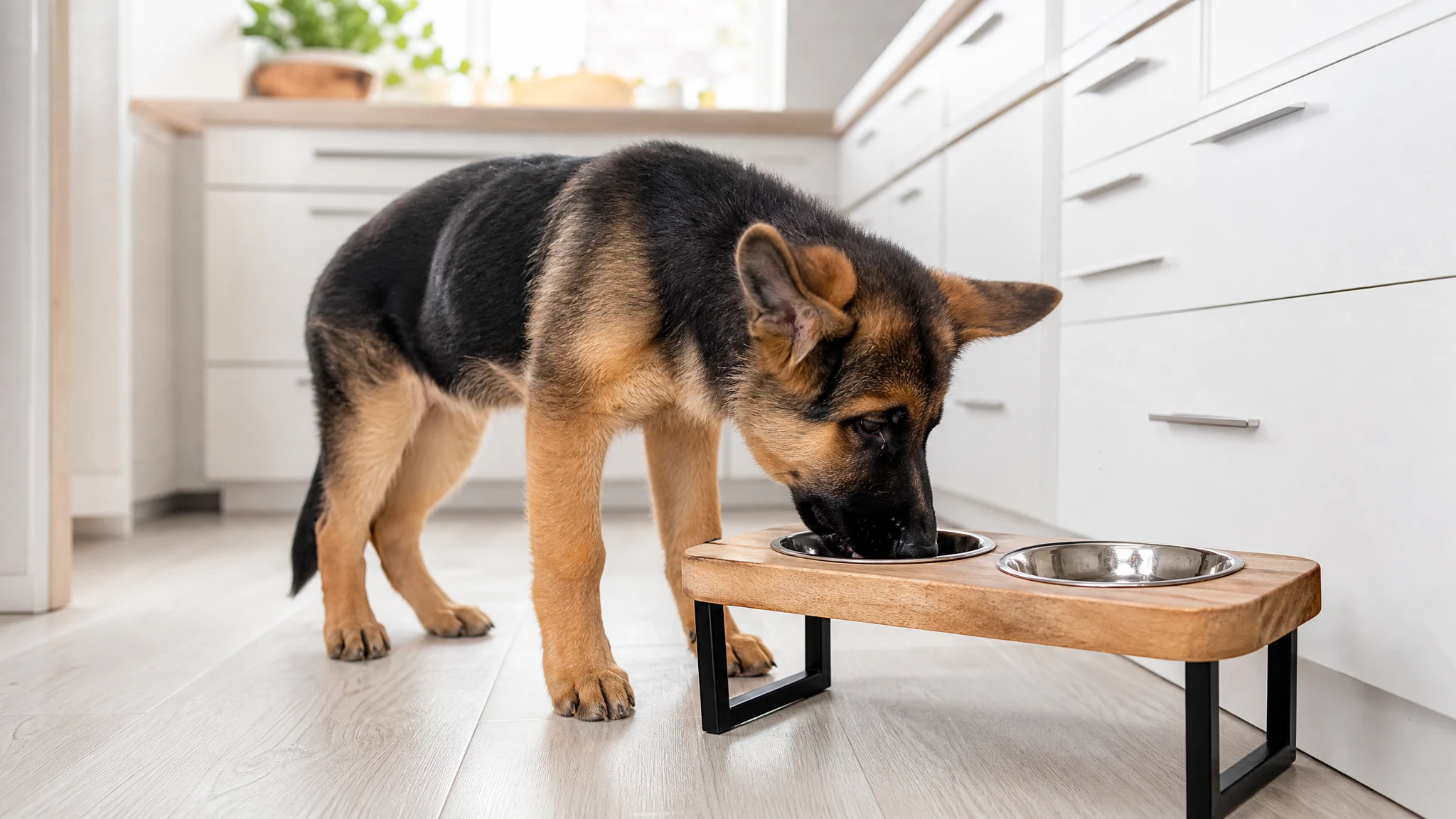
A good dog feeding station is not a gadget. It is a calm, consistent spot where your puppy eats, drinks, and learns that meals happen on a routine. For a German Shepherd puppy, the setup matters a little more than it does for a small breed, because this is a large dog that grows fast.
This guide shows you how to build a simple, safe feeding station at home. It does not rank products, and it does not recommend a particular bowl or stand. Feeding stations are mostly about placement, routine, and observation, and no brand claim changes that.
One note on method: we did not test or feed any bowls, stands, or foods ourselves. What follows draws on published guidance from veterinary and breed sources, listed at the end.
Why the Feeding Station Matters for This Breed
The German Shepherd Dog is a large breed. Hill's Pet Nutrition lists the adult weight at about 50 to 90 pounds, with males heavier. That is a lot of growing to do, and how and where a puppy eats can shape habits for years.
Two points from published sources shape how you should set up the station.
- Bloat risk. The Merck Veterinary Manual lists German Shepherd Dogs as an at-risk breed for gastric dilatation and volvulus (GDV, often called bloat). It names once-daily feeding, dry kibble only, and fast eating among the risk factors, and it advises multiple small meals. A station that slows a puppy down and supports several meals a day fits that advice.
- Staying lean. The Orthopedic Foundation for Animals (OFA) says that preventing overweight reduces mechanical stress on the hips, and Hill's notes that the breed is prone to developmental joint disorders. A station that makes portions easy to measure helps you keep control of calories.
A feeding station cannot prevent any condition. It can make good habits easier to follow. Your veterinarian decides what is right for your individual puppy.
Materials You Will Need
You likely own most of this already. Choose by function, not by price or brand.
- Two bowls, one for food and one for water. Stainless steel or ceramic are easy to wash. Pick a wide, stable bowl that will not tip when a strong puppy shoves it.
- A non-slip mat. It keeps bowls from sliding and catches spilled water and kibble.
- A measuring cup. A standard 8 oz. measuring cup is the kind VICTOR's feeding chart assumes, so use a real cup, not a scoop that came with another product.
- A kitchen scale (optional). Some owners weigh portions for more consistent amounts.
- A slow-feeding bowl or a food-dispensing toy (optional). These can help a fast eater. Choose sturdy ones sized for a large puppy, and watch for chewing damage.
- A lidded storage container. It keeps kibble in a cool, dry place, ideally in its original bag set inside the container so you keep the lot number and label.
- A notebook or phone note. You will use it to track portions, body condition, and stool quality.
- The feeding guide from your puppy's food label. You will need it for the starting amount.
Step-by-Step: Setting Up the Station
Step 1: Pick a quiet, low-traffic spot
Choose a corner of the kitchen, a utility room, or a hallway nook. Avoid the busiest doorway. A puppy that feels crowded may gulp food, and gulping is exactly what you want to discourage in this breed.
Pick a floor that is easy to clean. Tile and vinyl work better than carpet for the water bowl.
Step 2: Lay the mat and set the bowls
Put the mat flat against the wall so the puppy cannot push it around. Place the food bowl and water bowl side by side, with a little gap between them so water does not splash into the food.
Keep the setup the same every day. Puppies like predictability, and a fixed location tells your German Shepherd where meals happen.
Step 3: Decide on bowl height with your veterinarian
You will see raised feeders marketed to large-breed owners. The sources we relied on do not settle whether raised or floor-level bowls are better for bloat risk, so we make no claim either way. Ask your veterinarian which height suits your puppy, especially because the Merck Veterinary Manual flags this breed as at risk.
If you use a stand, make sure it is stable and that the bowl cannot be tipped or carried off. Adjust as your puppy grows, since a young German Shepherd gains height quickly.
Step 4: Find the starting amount on the label
Every complete puppy food prints a feeding guide. Treat it as a starting point, not a fixed rule. For example, Royal Canin's German Shepherd puppy page lists daily amounts by puppy age (2 to 12 months) and by expected adult weight (57, 77 or 97 pounds). Hill's says to adjust feeding amounts as needed to maintain optimal weight, and to ask your veterinarian if unsure.
Use the guide for the food you actually buy. Amounts differ between foods because calorie density differs. Among the label data we compared, the listed calories per cup ranged from 331 kcal for Royal Canin German Shepherd Puppy to 390 kcal for Hill's Science Diet Puppy Chicken & Brown Rice. The same cup of food can mean different calories, so never copy a portion from one brand to another.
For a deeper look at amounts by age, see our German Shepherd puppy feeding chart. Confirm any amount with your veterinarian, particularly during the large-breed growth period, because a vet can weigh your puppy and judge body condition.
Step 5: Split the day into several small meals
The Merck Veterinary Manual advises multiple small meals for at-risk breeds and lists once-daily feeding as a risk factor. Divide your puppy's daily amount across several feedings at regular times.
Brand guides vary on how many. VICTOR's page for its Grain Free Active Dog & Puppy suggests four feeding intervals spaced through the day. Freshpet's page says its quantities can be fed as one meal daily or divided into two. Given the breed's bloat risk, ask your veterinarian how many meals suit your puppy at each age, and do not assume a single-meal option fits a German Shepherd.
Whatever the schedule, pick set times and stick to them. Write them down so everyone in the household feeds the same way.
Step 6: Serve the meal and stay nearby
Put the measured food in the bowl. Ask your puppy to sit, and set the bowl down when all four paws are planted. This is a reward-based habit: calm behavior earns the meal. Use your voice and the food itself as the reward, with no force or physical corrections.
Stay close for the first minutes. Watch how fast the puppy eats. If the bowl is empty in seconds, move to a slow-feeding bowl or scatter part of the meal in a food toy.
Step 7: Pick up the bowl and wait before play
Some labels suggest a time limit. VICTOR's page, for example, mentions feeding what the puppy will eat in 20 minutes. If food is left over, pick up the bowl rather than leaving it out all day. This keeps portions accurate and meals on a schedule.
Many owners keep the puppy calm after eating instead of starting hard play. Ask your veterinarian for specific guidance on timing around exercise for a deep-chested breed.
Step 8: Keep water available and clean
Refill the water bowl fresh each day, and wash both bowls daily with hot soapy water. Puppies often drag food into water, so check it more than once.
Step 9: Track and adjust
Once a week, check your puppy's body shape. You should be able to feel the ribs under a light covering of flesh, and see a waist from above. If your puppy looks heavy or thin, do not simply change the cup size. Call your veterinarian.
Write down any changes in appetite or stools. The Hill's breed page notes that exocrine pancreatic insufficiency (EPI) is a documented breed predisposition, with signs that include weight loss despite a normal appetite and abnormal stools. Those signs are worth a prompt call to your vet.
Choosing the Right Food for the Station
The station only works if the food is appropriate. For a German Shepherd puppy, check the adequacy statement on the bag.
Since the 2016 AAFCO change, foods labeled for growth or all life stages must say either "including growth of large size dogs (70 lb. or more as an adult)" or "except for growth of large size dogs." German Shepherd puppies can reach or approach 70 pounds, so look for the "including" wording. Whole Dog Journal makes the same recommendation, and notes that too much calcium can cause bone and joint abnormalities in large-breed puppies. Hill's likewise says puppy formulas with controlled calcium and phosphorus support skeletal development.
Some foods that carry that large-size wording, based on their own product pages:
- Royal Canin German Shepherd Puppy (dry), which states it meets AAFCO levels for growth including large size dogs.
- VICTOR Hi-Pro Plus Large Breed Puppy (dry), labeled for all life stages including growth of large size dogs.
- Hill's Science Diet Puppy Large Breed Chicken & Brown Rice (dry), which cites AAFCO feeding tests for growing puppies.
This is a comparison of label data only. We did not run feeding trials or taste tests, and a listing here is not an endorsement. If you are considering a grain-free formula, know that the FDA has not established a causal link between specific diets and canine dilated cardiomyopathy (DCM), and its last public update was dated December 23, 2022. Talk with your veterinarian about your puppy's diet.
| Station habit | What to do | Why it helps |
|---|---|---|
| Meal frequency | Several small meals at set times | Merck lists once-daily feeding as a bloat risk factor |
| Eating speed | Watch, and use a slow feeder if needed | Merck lists fast eating as a risk factor |
| Portions | Measure with a real cup or a scale | Helps keep your puppy lean, which OFA links to lower hip stress |
| Food label | Look for "including growth of large size dogs" | Matches the AAFCO large-size growth wording |
Tips for a Smoother Routine
- Keep the area free of other pets. If you have another dog or a cat, feed them in separate spots so your puppy does not rush or guard.
- Make food changes gradually. Hill's suggests switching over 7 days for its large breed lamb recipe. Mix old and new food in shifting proportions.
- Rinse and dry bowls. Leftover residue builds up quickly, especially with fresh or moist foods.
- Use treats sparingly. Training treats count toward daily calories. Reduce meal amounts a little if you give many, and ask your vet how much.
- Re-check amounts as your puppy grows. A label guide that fits at 3 months will not fit at 8 months. Revisit the guide and your vet's advice at each stage.
Common Mistakes to Avoid
- Free feeding all day. A full bowl left out makes portions hard to track and meals unpredictable.
- One big meal. The Merck Veterinary Manual lists once-daily feeding as a risk factor for bloat in at-risk breeds.
- Trusting the bag alone. The label gives a starting point. Your puppy's body condition and your vet's weigh-ins decide the real amount.
- Using an adult formula too early. The sources we reviewed did not give a breed-specific age for switching to adult food. Ask your veterinarian when to change.
- Taking food away by force. Never punish or physically correct a puppy at the bowl. Teach manners with rewards instead, in line with American Veterinary Society of Animal Behavior (AVSAB) guidance. If your puppy guards food, ask your vet or a qualified trainer who uses reward-based methods.
- Adding supplements on your own. Do not add calcium or other supplements to a growing large-breed puppy's food without veterinary direction. Too much calcium is a concern for large-breed puppies, per Whole Dog Journal.
- Letting a puppy run hard right after meals. Ask your vet about timing.
What to Expect
A consistent feeding station may help your puppy settle into predictable meals and calmer eating. Many owners find that clear routines make house training and daily schedules easier too. Results vary by puppy, and no setup guarantees a particular outcome.
Careful portioning and regular weight checks may help you keep your German Shepherd at a healthy weight as it grows. Whether that supports joint health in your individual dog is a question for your veterinarian.
Call your vet if your puppy stops eating, vomits repeatedly, has a swollen or hard belly, retches without producing anything, or seems restless and in pain. Those can be emergencies in a deep-chested breed.
Quick Setup Checklist
- Choose a quiet, easy-to-clean spot.
- Lay a non-slip mat and place stable food and water bowls.
- Ask your vet about bowl height.
- Read the label feeding guide and treat it as a starting point.
- Divide the day's food into several small meals at set times.
- Reward a calm sit before serving.
- Pick up leftovers, and keep fresh water out.
- Check body condition weekly and confirm amounts with your vet.
Sources
- Merck Veterinary Manual, Gastric Dilation and Volvulus in Small Animals
- Orthopedic Foundation for Animals, Hip Dysplasia
- Hill's Pet Nutrition, German Shepherd breed page
- Whole Dog Journal, In the Fine Print: Nutritional Adequacy Statements
- FDA Center for Veterinary Medicine, Investigation into Potential Link between Certain Diets and Canine Dilated Cardiomyopathy
- Royal Canin, German Shepherd Puppy product page
- VICTOR, Hi-Pro Plus Large Breed Puppy product page
- Hill's, Science Diet Puppy Large Breed Chicken & Brown Rice product page